TAEDEL311 Provide work skill instruction

The TAEDEL311 Provide work skill instruction unit of competency is an elective unit for the TAE40122 Certificate IV in Training and Assessment qualification. And it is highly likely that this unit will be selected as one of the elective units.

This article outlines and clarifies the TAEDEL311 unit.

Understanding the terminology

I have found that the TAEDEL311 Provide work skill instruction unit of competency has used clumsy terminology. It uses terminology that wouldn’t be used in the workplace. I have never heard someone in the workplace say that they are going to ‘provide work skill instruction’. It would be common for someone to say that they are going to ‘deliver training’.

Therefore, the very first thing we need to do is understand the terminology used in the TAEDEL311 Provide work skill instruction unit.

  • What is instruction?
  • What is a work skills?

What is instruction?

To understand the TAEDEL311 unit of competency, we need to understand what is meant by ‘instruction’. Instruction and training are often used interchangeably. Therefore, we can replace the word ‘instruction’ with ‘training’.

The application statement for the TAEDEL311 Provide work skill instruction unit infers that it is about conducting training for an individual and small groups. The size of the small group could be two or three learners.

The TAEDEL411 Provide vocational training unit of competency covers the delivery of training to groups of at least four learners. This is a relatively small group size for most trainers and TAFE teachers.

What is a work skill?

A skill is the ability to do something. Therefore, a work skill is the ability to do something at work.

In the Australian VET system, there are two prime domains of learning: knowledge and skills. The title of the TAEDEL311 Provide work skill instruction unit focuses us on conducting skills training, rather than knowledge training. In others words, the training is to help a person learn how to perform a work skill or work task. It is not about helping someone learn some knowledge.

What is the difference between a work skill and a work task?

A work skill is a specific ability that is required to perform a particular job or task effectively. It can be a technical skill or a foundation skill, such as:

  • Use a chainsaw (is an example of a technical skills)
  • Speak with others (is an example of a foundation skill).

A work task, on the other hand, refers to a specific activity that needs to be completed as part of a job or project. It can be a one-time task or a recurring responsibility, and it may require the use of one or more work skills to accomplish it. Here are some examples of a work task:

  • Cut down a tree (using a chainsaw)
  • Present product features and benefits to a customer.

In summary, work skills are the abilities that are needed to perform work tasks effectively, while work tasks are the specific activities that need to be completed as part of a job or project.

Translating the TAEDEL311 unit

Also, the elements and performance criteria for TAEDEL311 Provide work skill instruction unit of competency uses terminology that require translating in a way that reflects how people speak in the real workplace.

The following table shows the elements of competency compared with my description of the task relating to training to an individual or a small group.

My description of the task uses simple and common language that would typically be used in a workplace. It should be noted that the context for ‘training’ is about helping people to learn to perform work skills or work tasks, and this training is likely to be short duration (one or a small number of training sessions).

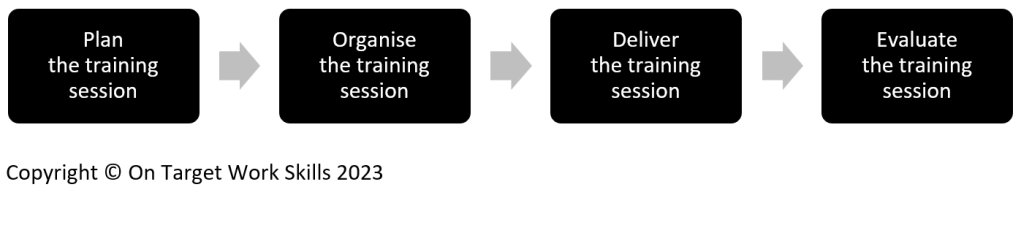
The following flowchart illustrates the description of the training process or task.
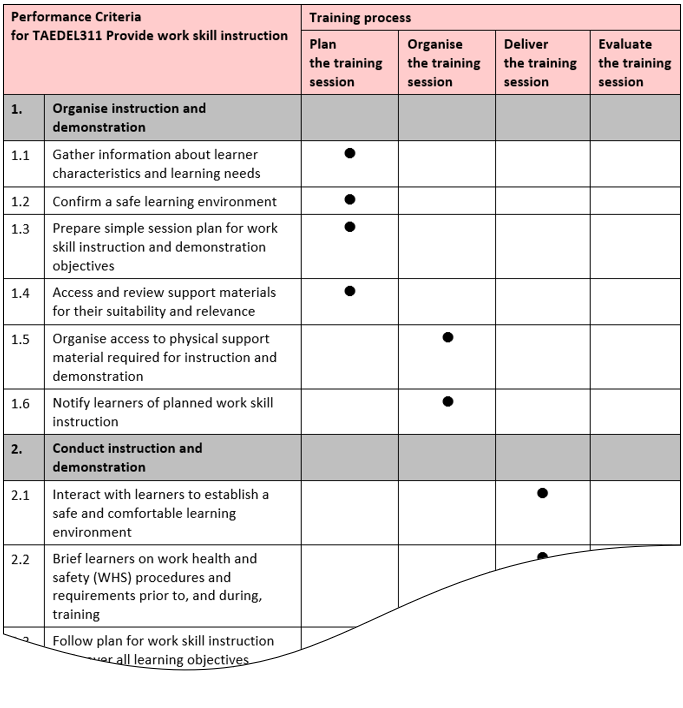
And the following matrix shows how my description of the training process can be mapped to the performance criteria for the TAEDEL311 unit.
Unpacking the TAEDEL311 unit

The required knowledge for the TAEDEL311 unit is specified by the Knowledge Evidence. And the required skills for the TAEDEL311 unit are specified by the Foundation Skills. If you are studying for your TAE40122 qualification, and you don’t yet know what Knowledge Evidence and Foundation Skills are, you will find out about these things later in your studies.

Required knowledge for the TAEDEL311 unit

The following required knowledge is specified by the TAEDEL311 unit:

  • Organisational procedures for gathering feedback from learners on work skill instruction [KE1]
  • Learner characteristics and needs [KE2]
  • Information included in a plan for work skill instruction: [KE3]
    • Session plan, consisting of session objectives, content to be covered, and delivery approach to be used
    • Task breakdown
    • Timing
  • Sources, availability and content of suitable support materials [KE4]
  • Training facilitation and coaching techniques to support adult learning relevant to work skill instruction, and when to use them [KE5]
  • Overview of adult learning principles and their application to work skill instruction [KE6]
  • Key steps for practising self-reflection on own work skill instruction to identify opportunities for improvement [KE7]
  • Sources of assistance relating to contextualising support materials to the workplace [KE8]
  • Work health and safety (WHS) issues in the learning environment, including: [KE9]
    • Roles and responsibilities of key personnel
    • Responsibilities of learners
    • WHS policies and procedures, including those relating to hazard and risk identification, and safe use of equipment and emergency procedures
    • Risk controls for the specific learning environment.

Required skills for the TAEDEL311 unit

The following required skills are specified by the TAEDEL311 unit:

  • Reading: Sources and interprets processes and procedures, support materials, and information relevant to providing work instruction [FS1]
  • Writing: Completes required workplace documentation using appropriate language and format [FS2]
  • Oral communication: Uses communication techniques to build rapport, monitor progress and provide feedback to learners [FS3]
  • Numeracy: Interprets and uses scheduling and sequencing information, and estimates time [FS4]
  • Initiative and enterprise: Asks questions to clarify understanding, and to provide and seek feedback [FS5]
  • Initiative and enterprise: Identifies and responds to potential risks, problems and opportunities for improvement and considers options for different approaches [FS6]
  • Planning and organising: Organises and completes work according to defined requirements, taking responsibility for some decisions and sequencing tasks to achieve efficient outcomes [FS7]
  • Teamwork: Builds rapport and establishes productive working relationships to achieve learning outcomes [FS8]

Knowledge and skills required to deliver training to an individual or small group

The following tables shows how the required knowledge and skills can be mapped to each performance criteria for the TAEDEL311 unit.

And the following table shows how the required knowledge and skills can be mapped against my description of task to help people to learn to perform work skills or work tasks.

In conclusion

The TAEDEL311 Provide work skill instruction unit of competency can be described as a 4-step training process:

  • Step 1. Plan the training
  • Step 2. Organise the training
  • Step 3. Deliver the training
  • Step 4. Evaluate the training.

Do you need help with your TAE studies?

Are you a doing the TAE40122 Certificate IV in Training and Assessment, and are you struggling with your studies? Do you want help with your TAE studies?

Ring Alan Maguire on 0493 065 396 to discuss.

Contact now!

logo otws

Training trainers since 1986

If Thing 1 is ChatGPT, then Thing 2 is the new Microsoft Bing

Everyone may be talking about ChatGPT, but what about the new Bing?

I had the new Bing pushed onto my computer on the 15th of March, 2023. And I finally got around to looking at it today.

What is the new Bing?

The new Bing is Microsoft’s revamped search engine that provides up-to-date and complete answers to your questions. It consolidates sources across the internet to give you a single, summarised answer. It also cites the sources of information. The new Bing is powered by ChatGPT-4, but it gives a different experience to the user.

What is the different between ChatGPT and the new Bing?

ChatGPT and Bing Chat are both AI chatbots that can understand when you ask them questions or make statements in natural, human language. Both services support a range of languages, though ChatGPT is more focused on English, where Bing Chat offers a wider array of non-English languages.

Bing Chat is available on more platforms than ChatGPT, including Android, iOS, and even the Skype app. However, it currently requires you to join a waitlist whereas you can use ChatGPT immediately. Bing primarily functions as a search engine, so the new Chat feature can access web results and up-to-date information.

ChatGPT has an optional paid Plus subscription, which grants you priority access over the free tier. Bing is also free to use, but Microsoft restricts the number of conversations you can have per day.

Note: The above answer was provided by the new Bing.

What restrictions has Microsoft put on Chat function?

Currently, the Bing Chat allows up to 15 chat items per session and a total of 150 chat items per day. These restrictions may change over time. Microsoft introduced these restrictions for Bing Chat because long sessions can ‘confuse’ the program’s computing model and produce uneven or inappropriate responses.

What does the Bing Chat look like?

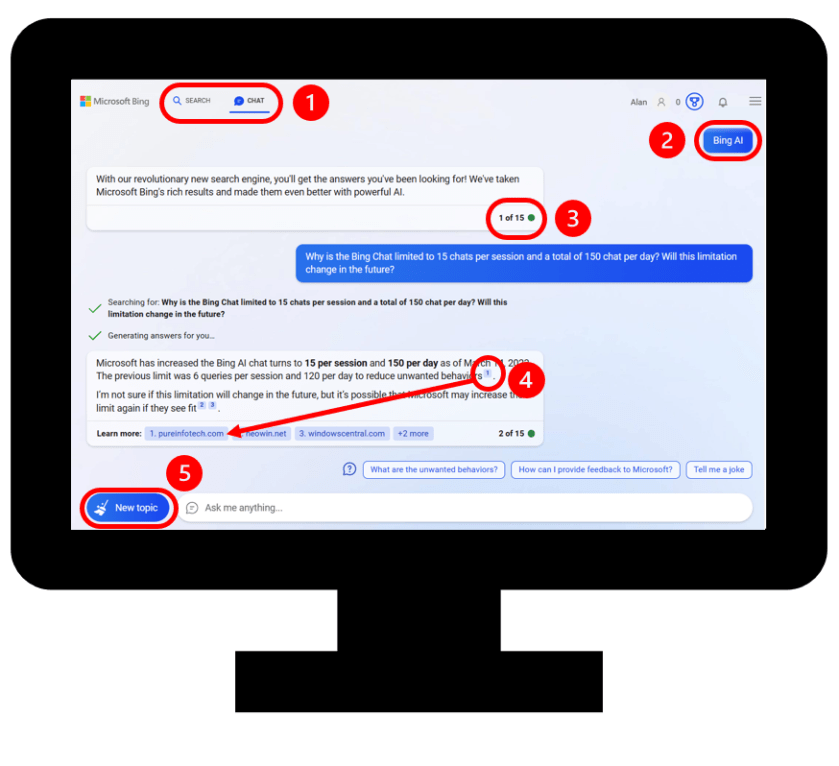
The following illustrates what the Bing Chat looks like. In ‘red’, I have highlighted a few points (see below for my comments).

  1. The new Bing allows us to toggle between searching the internet and using the chat function. This is a useful feature.
  2. Our questions are left-justified and the responses are right-justified. ChatGPT left justifies both questions and response which I find better for readability.
  3. The number of chat items in a session are clearly recorded as 1 of 15, 2 of 15, etc. Remember that each chat is restricted to 15 items.
  4. The new Bing clearly cites the sources of the information and it provides a link to the web page. This is useful for verifying the information.
  5. A new chat for a new topic can be easily started. However, when you start a new topic the previous topic is removed. It does a ‘clean sweep’ of the previous chat.

Is the new Bing Chat any good?

The new Bing Chat is impressive. It provides a different user experience than ChatGPT. For example, I found the new Bing slower to respond than ChatGPT, but I am talking about having to wait a few more seconds.

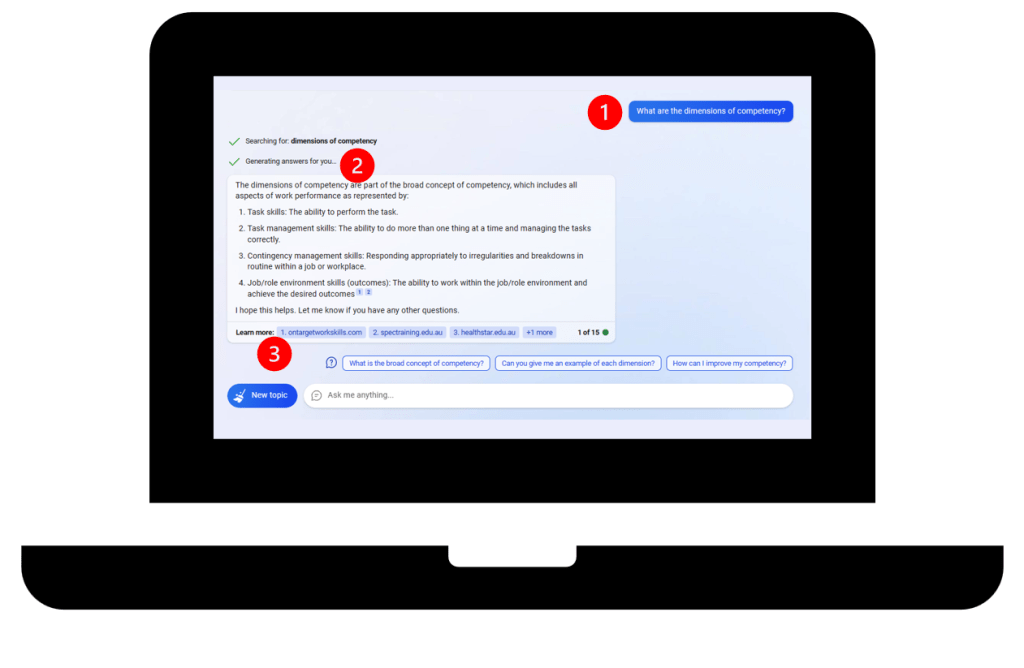
I asked Bing Chat, “What are the dimensions of competency?” Within 15 second I was given the correct answer and it was within the context of the Australian VET system. I hadn’t specified the context but it was exactly what I was wanting.

The following show my question and the answer I received. In ‘red’, I have highlighted a few points (see below for my comments).

  1. This was my questions.
  2. This was the answer to my question.
  3. The answer must be good since it has cited my website as a source of the information it has provided. (And my ontargetworkskills.com website was listed as number 1!)

Upcoming webinar

I am delivering a webinar titled, ‘ChatGPT and how to use it before and during training’. At this webinar, I will include information about the new Bing.

If you would like to attend this webinar, follow this link for details : ChatGPT and how to use it before and during training.

Ring Alan Maguire on 0493 065 396 if you would like further information.

Contact now!

logo otws

Training trainers since 1986
What is neurodiversity? And what do trainers need to know about it?

Background

The TAEDEL411 Facilitate vocational training is a core unit of competency for the new TAE40122 Certificate IV in Training and Assessment qualification. It describes the skills and knowledge required to plan, prepare and deliver training within the Australian VET system.

A range of required knowledge are specified. And one piece of knowledge relates to the training methods and techniques that can be used to support effective learning. Not every learner is the same. Learners can have different characteristics, needs, and behaviours.

The TAEDEL411 Facilitate vocational training unit of competency identifies the following three characteristics that trainers must know how to respond to:

  • cultural and social practices
  • mental health and wellness considerations
  • neurodiversity.

This article will describe what neurodiversity is, and identify training methods and techniques that can be used to support effective learning for learners who are neurodiverse.

What is neurodiversity?

Neurodiversity refers to the natural variations in brain function and behaviour that are considered normal, such as differences in attention, perception, and learning styles. This concept views these differences as a form of diversity rather than as a disorder or deficit, and seeks to promote acceptance, understanding, and support for people with neurodiverse conditions like autism, ADHD, dyslexia, and others.

Neurodiversity is not a scientific term, but rather a cultural and political movement that aims to challenge negative attitudes and stereotypes, and promote equal opportunities and accommodations for people with neurodiverse conditions.

How does autism, ADHD and dyslexia differ?

Autism Spectrum Disorder (ASD), Attention Deficit Hyperactivity Disorder (ADHD), and dyslexia are three distinct neurodevelopmental conditions that can impact an individual’s functioning in different ways.

Autism Spectrum Disorder (ASD) affects social interaction, communication, and behaviour. Individuals with ASD may struggle with social interactions and communication, and may display repetitive behaviours or interests.

Attention Deficit Hyperactivity Disorder (ADHD) is a condition that affects attention, hyperactivity, and impulsivity. Individuals with ADHD may struggle with focus, staying on task, and controlling their impulses.

Dyslexia is a specific learning disorder that affects reading and processing written language. Individuals with dyslexia may have difficulty decoding words, recognising letters, and comprehending text.

While these conditions are distinct, they can also overlap and co-occur. For example, individuals with autism or ADHD may also have dyslexia, and individuals with dyslexia may also have attention difficulties. It is important to note that each individual is unique and may experience these conditions differently. A comprehensive evaluation is typically necessary to diagnose and distinguish between these conditions.

How can trainers support effective learning for a person with autism?

Trainers can support effective learning for a person with autism in a number of ways, such as:

  • Creating a structured and predictable learning environment: Individuals with autism tend to do well with structure and routine. Providing a consistent and predictable learning environment can help reduce anxiety and support learning.
  • Using clear and concise language: Individuals with autism may have difficulty understanding and processing complex language or figurative language. Using simple, clear, and concise language can help ensure that the learner understands the material.
  • Using visual aids: Many individuals with autism are visual learners and may benefit from the use of visual aids such as diagrams, pictures, and videos to support learning.
  • Providing opportunities for hands-on learning: Individuals with autism may benefit from hands-on learning opportunities that allow them to explore and manipulate materials.
  • Incorporating the learner’s interests: Many individuals with autism have strong interests in particular topics. Incorporating these interests into the learning material can help engage the learner and increase their motivation to learn.
  • Allowing breaks and sensory regulation: Individuals with autism may experience sensory overload or have difficulty regulating their sensory input. Allowing breaks or providing sensory regulation tools, such as a fidget items or noise-cancelling headphones, can help the learner manage their sensory needs and stay focused.

How can trainers support effective learning for a person with ADHD?

Trainers can support effective learning for a person with ADHD in the following ways:

  • Providing clear and concise instructions: People with ADHD may have difficulty processing lengthy or complicated instructions. Trainers can break down instructions into smaller, more manageable steps to help learners with ADHD stay focused.
  • Using visual aids: Visual aids such as diagrams, pictures, and videos can help learners with ADHD better understand and retain information.
  • Minimising distractions: Trainers can create a distraction-free learning environment by reducing noise levels, removing unnecessary objects, and limiting interruptions.
  • Incorporating movement breaks: People with ADHD may benefit from short, frequent breaks that allow them to move and release excess energy. Trainers can incorporate movement breaks into the learning experience to help learners with ADHD stay engaged.
  • Providing positive reinforcement: Trainers can use positive reinforcement techniques, such as praise or rewards, to motivate learners with ADHD and reinforce desired behaviours..
  • Allowing for flexibility: People with ADHD may have difficulty adhering to strict schedules or routines. Trainers can allow for flexibility in the learning experience, such as allowing extra time for assignments or providing alternative methods of demonstrating knowledge.
  • Communicating regularly: Regular communication between trainers and learners with ADHD can facilitate progress monitoring, feedback provision, and adjustment making as necessary. This, in turn, can promote a sense of support and keep learners with ADHD on track during the learning process.

How can trainers support effective learning for a person with dyslexia?

Here are some ways in which trainers can support effective learning for a person with dyslexia:

  • Using multisensory approaches: People with dyslexia may benefit from multisensory learning experiences that engage multiple senses, such as visual, auditory, and kinaesthetic. Trainers can incorporate activities that involve writing, drawing, listening, and moving to help learners with dyslexia better understand and retain information.
  • Providing extra time: People with dyslexia may need extra time to process information, read and write. Trainers can provide additional time for assignments and assessments to allow learners with dyslexia to work at their own pace.
  • Using assistive technology: Assistive technology, such as text-to-speech software, can help learners with dyslexia access written material more easily. Trainers can incorporate the use of assistive technology into the learning experience to support learners with dyslexia.
  • Simplifying language: Trainers can simplify language by using shorter sentences, less complex vocabulary, and providing examples to help learners with dyslexia better understand concepts.
  • Providing positive reinforcement: Trainers can use positive reinforcement techniques, such as praise or rewards, to motivate learners with dyslexia and reinforce desired behaviours.
  • Allowing for flexibility: Trainers can allow for flexibility in the learning experience, such as providing alternative methods of demonstrating knowledge or allowing learners to work independently.
  • Communicating regularly: Trainers can communicate regularly with learners with dyslexia to monitor progress, provide feedback, and make adjustments as needed. This can help learners with dyslexia stay on track and feel supported throughout the learning process.

In conclusion

This article has explored neurodiversity as one of three learner characteristics identified by the TAEDEL411 Facilitate vocational training unit of competency.

Trainers can support effective learning for individuals who are neurodiverse by understanding their unique learning styles and needs, and adapting training strategies accordingly.

The following is a summary of some training methods and techniques for trainers to use:

  • Creating a structured and predictable learning environment
  • Simplify language
  • Use clear and concise instructions
  • Minimise distractions
  • Incorporate the learner’s interests
  • Use visual aids
  • Use multisensory approaches
  • Provide opportunities for hands-on learning
  • Incorporate movement breaks
  • Provide extra time
  • Allow for flexibility
  • Communicate regularly
  • Providing positive reinforcement.

Note: ChatGPT has been used to gather content for this article.

Do you need help with your TAE studies?

Are you a doing the TAE40122 Certificate IV in Training and Assessment, and are you struggling with your studies? Do you want help with your TAE studies?

Ring Alan Maguire on 0493 065 396 to discuss.

Contact now!

logo otws

Training trainers since 1986

Sneak preview of webinar about ChatGPT and how to use it for training purposes

Anyone who knows me, knows that I love PowerPoint. And anyone who knows me, knows that I create PowerPoint presentations to support the delivery of training programs and webinars.

I am delivering an interactive webinar titled, ‘ChatGPT and how to use it before and during training’. This webinar includes real-time demonstration of ChatGPT and the opportunity for your questions to be asked.

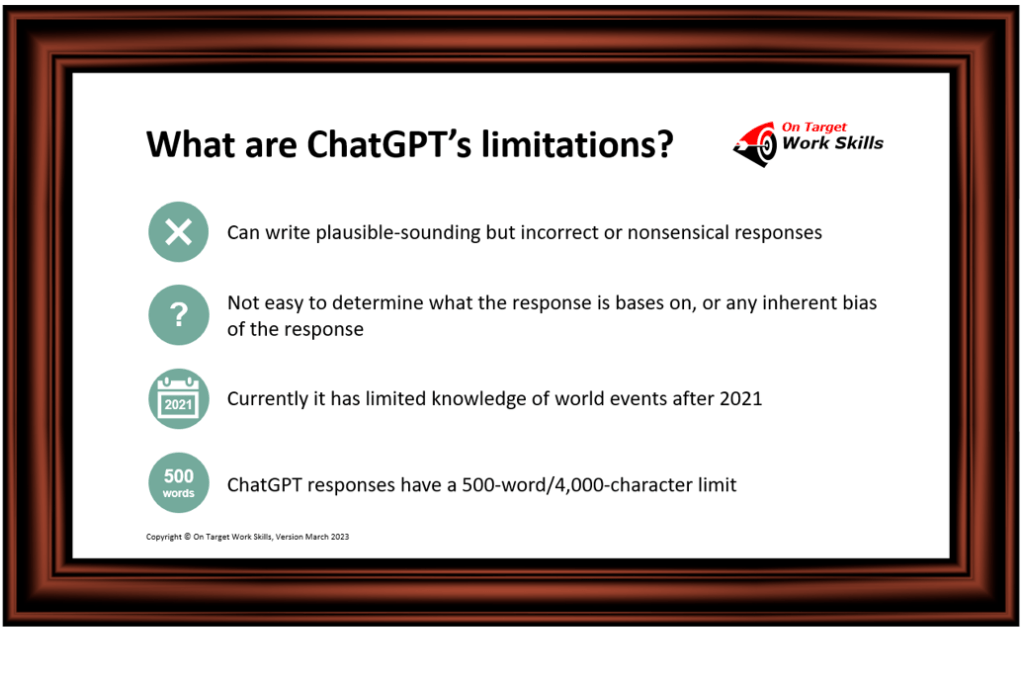
Here is a sneak preview of some PowerPoint slides that I have developed for this webinar. These cover some of the background information about ChatGPT before getting into how to use it for training purposes.

I hope you enjoy having a ‘walk-through the gallery’.

Come along to the webinar if you like to know more about how ChatGPT can be used for training purposes. Follow this link for details: ChatGPT and how to use it before and during training.

Ring Alan Maguire on 0493 065 396 if you would like further information.

Contact now!

logo otws

Training trainers since 1986

Are there 4 or 5 dimensions of competency?

If we search Google for ‘The 5th Dimension’ we will find information about the American popular music vocal group. They had many hit songs during the 1960s and 1970s. But what about the dimensions of competency in the Australian VET system? How many are there? And does it really matter? Some people say there are four dimensions of competency, while others say there are five.

These questions got me thinking about how much I detest the ‘dimensions of competency’ concept. It was useful in 1993 when Australia was implementing its ‘new competency-based training system’. At that time, it was necessary to educate people in the ‘new concept’ of competencies and how it differed from a curriculum-based approach.

I don’t think the dimensions of competency matter anymore to the ‘everyday’ trainer and assessor. Most ‘everyday’ trainers and assessors do not determine the content of the training to be delivered, and they do not develop the assessment tools to be used.

Also, I believe that the developers of Training Packages and VET Accredited Courses build the dimensions of competency into each unit of competency, as required. This includes considering how the ability to transfer skills and knowledge to new situations and environments are to be addressed. Australia has a mature VET system based on more than 25 years’ experience of developing Training Packages. I believe that new trainers and assessors need a more contemporary view about understanding and using competency standards.

However, it does not matter what I think. Many of the new TAE units of competencies release at the end of 2022 require knowledge of the dimensions of competency. Therefore, anyone studying for their TAE40122 Certificate IV in Training and Assessment qualification must know something about the dimensions of competency and how they are ‘theoretically’ used by trainers and assessors working for an RTO.

What are the dimensions of competency?

Dimensions of competency are part of the broad concept of competency, which includes all aspects of work performance as represented by: [1]

  • Task skills
  • Task management skills
  • Contingency management skills
  • Job/role environment skills.

Some people like to add a fifth dimension: Transfer skills.

Why do we still talk about the dimensions of competency?

(This article was originally published in 2019 but has been update in 2023.)

During 2019, when I did a Google search for the dimension of competency, I was presented with a limited or narrow range of results. Nothing seemed credible or relevant. I then searched the following reputable sources of VET information but could not find the term ‘dimensions of competency’:

  • ASQA website [2]
  • ASQA’s Users’ Guide to the Standards [3]
  • ASQA’s Guide to developing assessment tools [4]
  • Government of Western Australia, Department of Training and Workforce Development: Designing assessment tools for quality outcomes in VET, 4th Edition 2013 [5].

I think the only reason we still talk about the dimensions of competency is because it is listed as a Knowledge Evidence item in several TAE units of competency. This is not a good enough reason for regurgitating this unnecessary concept in today’s VET system. I am an experience developer of training and assessment materials. I am about to make a confession. I have never said to myself, “how am I going to incorporate the dimensions of competency?”

During the recent review of the TAE Training Package, I had recommended the removal this antiquated concept from the TAE40122 Certificate IV in Training and Assessment. Instead of removing the dimensions of competency, many more TAE units of competency have had it listed as Knowledge Evidence.

What do I think trainers and assessors need to know?

Trainers and assessors need to know the following:

  • Definition of competency
  • Definition of assessment
  • Principles of assessment
  • Rules of evidence.

If should be noted that the second sentence of the definition of competency covers what some people call the fifth dimension of competency:

the ability to transfer and apply skills and knowledge to new situations and environments.”

Also, I think trainers and assessor need to know how to read, interpret and contextualise competency standards. This requires a person to understand the structure and intent of the following:

  • Unit application
  • Elements and performance criteria
  • Foundation skills
  • Performance evidence
  • Knowledge evidence
  • Assessment conditions.

In conclusion

To answer the question: Are there 4 or 5 dimensions of competency ?

There are 4 dimensions. But whether there is 4 or 5, it is purely academic. Some people may disagree with me. That is okay. I am more pragmatic than academic.

Since 1997, Training Package developers have been incorporating the dimensions of competency into the units of competency.

Unfortunately, if you are studying for your TAE40116 or TAE40122 Certificate IV in Training and Assessment qualification, you will still need to know something about the these dimensions of competency.

The following articles provide further details about the four dimensions of competency:

On a positive note, the dimensions of competency remind us that a safe and productive worker must do more than focus on performing one task at a time. And when irregularities and break downs in routine occur, they must be able to respond.

References

[1] https://www.voced.edu.au/vet-knowledge-bank-glossary-vet accessed 17 March 2023

[2] https://www.asqa.gov.au/ accessed 25 October 2019

[3] https://www.asqa.gov.au/standards accessed 25 October 2019

[4] https://www.asqa.gov.au/sites/g/files/net3521/f/Guide_to_developing_assessment_tools.pdf accessed 25 October 2019

Do you need help with your TAE studies?

Are you a doing the TAE40122 Certificate IV in Training and Assessment, and are you struggling with your studies? Do you want help with your TAE studies?

Ring Alan Maguire on 0493 065 396 to discuss.

Contact now!

logo otws

Training trainers since 1986