

Introduction
The new ASK formatted units have removed information about the elements of competency and associated performance criteria. In the Australian VET system, competency is defined as the consistent application of knowledge and skills to the standard of performance required in the workplace. The key words I want to highlight in this definition are knowledge, skills, and performance.
Knowledge + Skills = Performance
Therefore, it is super important to identify the performance requirements when unpacking the unit of competency. Once the performance requirements have been identified, then the next important thing to do is reconstruct the pieces of information scattered across the unit of competency. This can be done by showing the connections between performance, knowledge, and skills.
Unpacking the UEEFS2003 unit
In this article, I shall use the newly released UEEFS2003 Work safely and sustainably in the energy sector unit of competency.
This is one of the first ASK formatted units that has been endorsed and released for implementation. It was developed by Powering Skills Organisation.
Step 1. Identify performance requirements
Performance requirements need to be extracted from two separate parts of the unit:
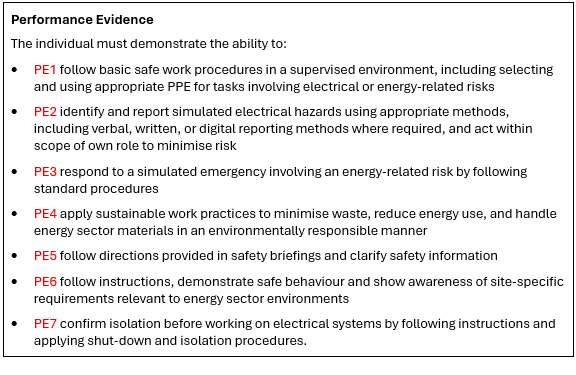
- Performance Evidence
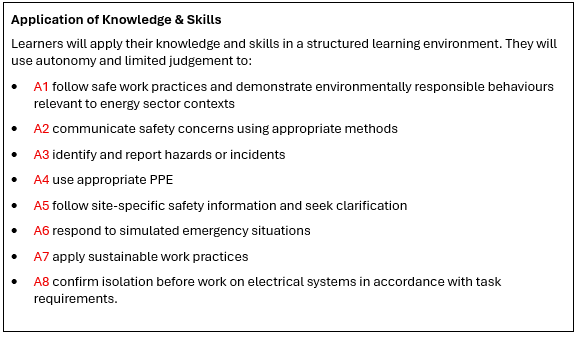
- Application of Knowledge & Skills
The following shows to the Performance Evidence for the UEEFS2003 unit. I have added the PE numbers.
The following shows to the Application of Knowledge & Skills for the UEEFS2003 unit. I have added the A numbers.
The following table shows the connection between the Performance Evidence and Application of Knowledge & Skills for the UEEFS2003 unit. I have added the coloured highlighting to show how they are connected.

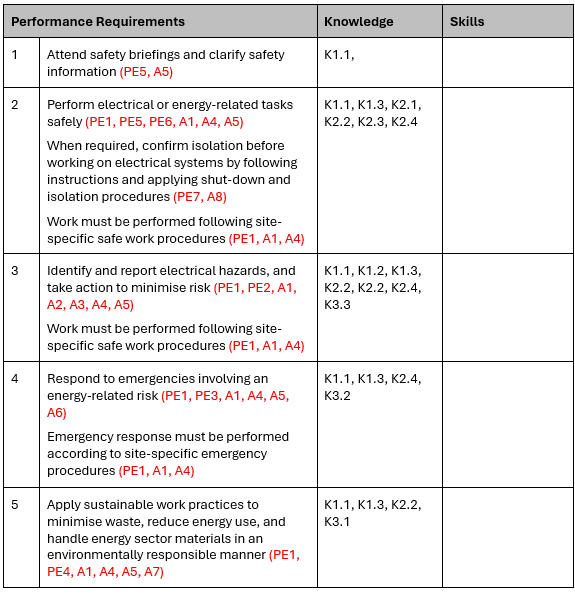
The following shows how I have integrated and consolidated information from the Performance Evidence and Application of Knowledge & Skills for the UEEFS2003 unit. It simplifies the information from two lists (total of 15 items) to one list consisting of five items that I have called Performance Requirements.

The above list of five Performance Requirements can be used for organising assessments tasks and training sessions.
Step 2. Reconstruct the pieces of information
Pieces of information are scattered across the unit of competency:
- Knowledge
- Knowledge Evidence
- Skills.
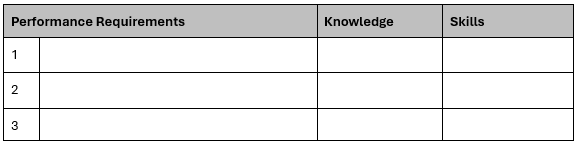
A table with the following structure can be used to reconstruct the pieces and show the connections between performance, knowledge, and skills.
The following shows the Knowledge items for the UEEFS2003 unit. I have added the K numbers.

The following shows how the Knowledge items relate to the Performance Requirements.
The UEEFS2003 unit has a large quantity of Knowledge Evidence items. There are 9 bullet points and 38 sub-bullet points, giving a total of 47 items of Knowledge Evidence.
The following shows an incomplete list of the Knowledge Evidence for the UEEFS2003 unit. I have added the KE numbers.

The following shows how the Knowledge Evidence items relate to the Performance Requirements.
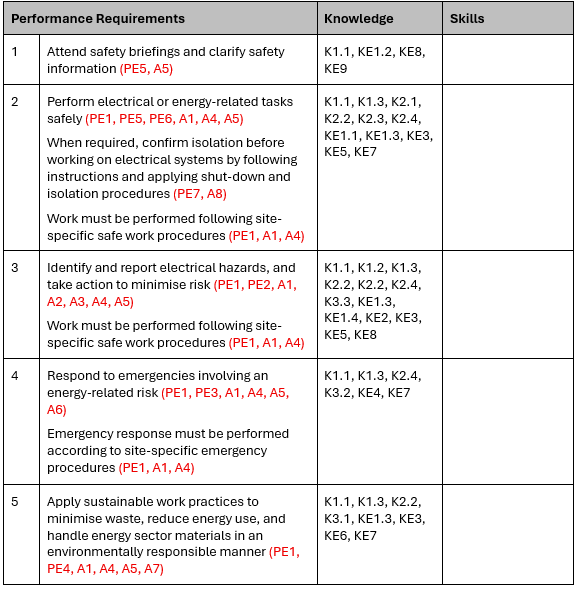
The following shows the Skills for the UEEFS2003 unit. I have added the S numbers.
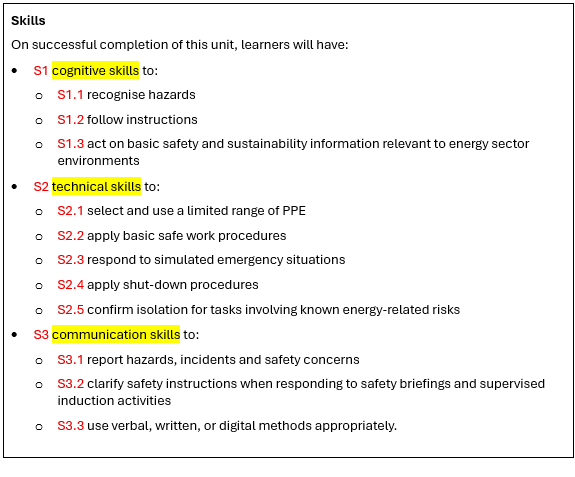
The following shows how the Skills items relate to the Performance Requirements.
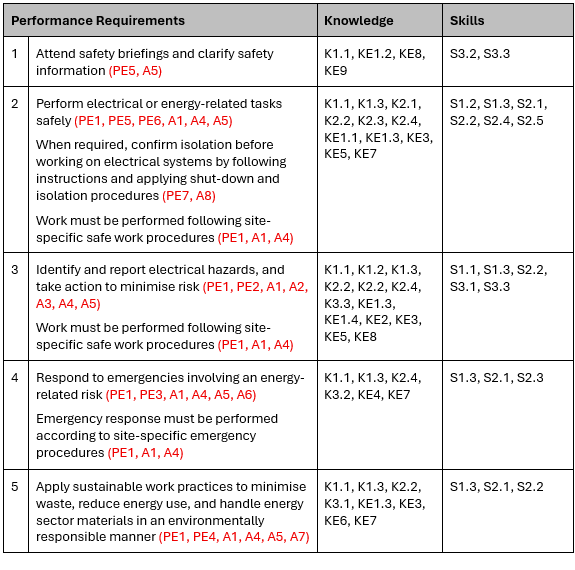
The above table clearly shows the connection between all the pieces of information from the UEEFS2003 unit. As previously stated, this list of five Performance Requirements, now showing the connection to knowledge and skills can be used for organising assessments tasks and training sessions.
Knowledge + Skills = Performance
Conclusion
This article has used one of the newly endorsed and released ASK formatted units to show how to:
- Extract pieces of information from a unit to identify performance requirements
- Use a table to connect performance requirements with the specified required knowledge and required skills.
A future article can demonstrate how the Performance Requirements can be used for organising assessment tasks and training sessions.
Many people look at, and read, my articles but don’t respond. If you have found this article interesting or somehow useful, please consider ‘Liking it’.

Also, I look forward to receiving for comments.
Do you want more information?
Are you an RTO manager or course coordinator?
Could your RTO team benefit from professional development about changes to the Australian VET system? In particular, how the Training Package Organising Framework or how the new EPC and ASK formatted units impact their work as VET practitioners?

Ring Alan Maguire on 0493 065 396 to discuss.

Training trainers since 1986


Dear Alan,
Thank you for choosing the unit that you did.
Your methodical analysis was excellent.
Indebted to your acumen, knowledge and professionalism.
LikeLike
Thank you Derek for your kind feedback.
LikeLike
Hi Alan
Love your work. What is interesting about this unit is some of the verbage is reflective of workplace application and more akin to an A type unit, such as PE 7 confirm isolation …
PE 7 in the unit would not be able to provide a learner the opportunity to ‘confirm isolation before working on electrical systems’. They may acquire knowledge about it, and they may be able to explain the process of confirming such, they may be able to simulate some aspects of confirming electrical isolation (with very low voltage equipment). So, in terms of assessment it is not clear how PE7 could legitimately be assessed at this level while remaining consistent with electrical safety, licensing and regulatory requirements.
This is one of the concerns I have with specifications of TPOF around ASK units and have aired my concerns publicly before. I support it in principle but suggested that a clear design spec needs to be applied to this type of template. They should aim to focus on knowledge and skills development as intended and be used as prerequisites to underpinning workplace application such as something like confirming isolation before working on electrical systems or as knowledge and skills acquisition or upskilling products.
I’d be happy to have a chat, because there is much variation and inconsistency emerging in their development and application across JSCs. Few including DEWR have conducted any national PD workshops on their proposed design philosophy and approach to ASK Unit development with industry stakeholders. Something that should have been done across the nation before rolling the new TPOF out, so that stakeholders could contribute to their development in an informed way. I have participated in many thus far and noted that many industry stakeholders are numb and unable to contribute in a practical way to their development. And so, they are developed without sufficiently informed stakeholder input.
Tony Palladino
LikeLike