

Introduction
The UEE22025 Certificate II in Electrotechnology (Career Start) qualification was released on the 25th of November 2025. Six months later, the UEE22226 Certificate II in Gateway to the Energy Sector qualification was endorsed, and on the 15th of June 2026 it was released.
Fun Fact: There are 57 RTOs that have added the UEE22025 Certificate II in Electrotechnology (Career Start) qualification to their scope of registration.
This article explores a range of initiatives and innovations relating to the current reforms to the Australian VET system.
There is a difference between a gateway and a pathway
The UEE22025 Certificate II in Electrotechnology (Career Start) qualification provides a pathway to an apprenticeship or traineeship. The UEE22226 Certificate II in Gateway to the Energy Sector qualification is a gateway training program. These two qualifications have a fundamental difference.
The UEE22025 Certificate II in Electrotechnology (Career Start) qualification aims to develop work skills and it provides credit towards an apprenticeship or traineeship. It starts a person’s career. It puts the person on a pathway to continue onto a Certificate III from the UEE Training Package.
The UEE22226 Certificate II in Gateway to the Energy Sector qualification does not develop work skills. It is like a secondary school subject or a relatively short training program to occupy someone’s time while they decide if employment in the energy sector is something they want to do.
The UEE22226 Certificate II in Gateway to the Energy Sector qualification has deliberately been created to not give credit towards an apprenticeship or traineeship. Also, it is unlikely that the attainment of the UEE22226 Certificate II in Gateway to the Energy Sector qualification could contribute to a future RPL application.
The shift from vocational training to vocational education
The UEE22226 Certificate II in Gateway to the Energy Sector qualification was released on the 15th of June 2026. It is the first ‘training product’ to be released that uses the formats specified by the Training Packaging Organising Framework 2025. The packaging rules for the UEE22226 Certificate II in Gateway to the Energy Sector qualification states that, “it is a core only qualification”, and it requires the completion of ten core units.
The ten core units created for the UEE22226 Certificate II in Gateway to the Energy Sector qualification are in the Application of Skills and Knowledge (ASK) format. An analysis of these units indicated a description of curriculum rather than competency. They are units of curriculum, not units of competency. This supports the shift from competency-based training to curriculum-based education.
The following are the ten units of curriculum that have been created for the UEE22226 Certificate II in Gateway to the Energy Sector qualification.
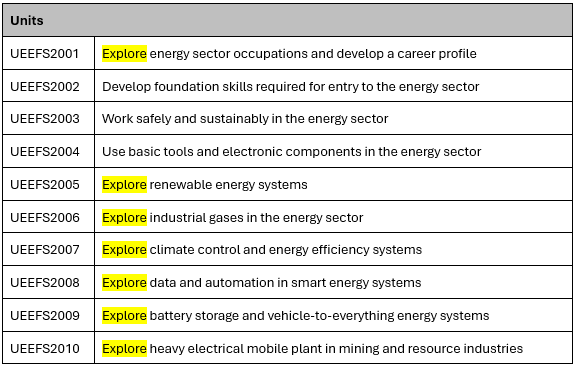
Seven exploration units. Units that develop a person’s capability to explore a subject. An innovation for the Australian VET system!
Curriculum-based education
The following is the first sentence of the Qualification description from the UEE22226 Certificate II in Gateway to the Energy Sector qualification.

This qualification has not been created to develop work skills. It immediately identifies the target audience as ‘learners’. This means school students or other people interested in exploring a career in the energy sector. The following has been extracted from the second paragraph of the Qualification description from the UEE22226 Certificate II in Gateway to the Energy Sector qualification.

This reinforces that this qualification is ‘schoolwork’ and it has a focus on developing the ability to research a ‘subject’ rather than learning to perform tasks in a workplace environment. The following has been extracted from the third and fourth paragraphs of the Qualification description from the UEE22226 Certificate II in Gateway to the Energy Sector qualification.

This shows how the delivery of this qualification must be done in a ‘school-like’ environment.
And finally, the Qualification description from the UEE22226 Certificate II in Gateway to the Energy Sector qualification states, “Graduates will be prepared to undertake further vocational education and training or pre-apprenticeship programs”.
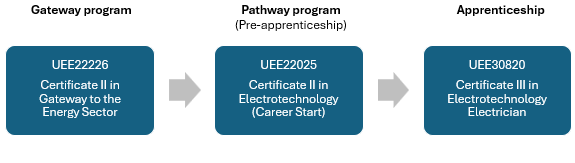
The above shows how a Certificate II qualification leads to a Certificate II qualification. However, there are variations to the above pathway.
Entry points: A person could start at the pre-apprenticeship program, or they could commence the apprenticeship without doing the gateway or pre-apprenticeship program.
Exit points: A person could complete the gateway program and stop, or they could complete the pre-apprenticeship and not continue the pathway.
It is said that Australia is facing a significant shortage of qualified electricians. Is the UEE22226 Certificate II in Gateway to the Energy Sector qualification likely to increase the number of people completing their apprenticeships and becoming qualified electricians?
Introducing foundation skills outcomes
The Training Package Organising Framework 2025 has introduced a new template for qualifications. Qualifications shall now include Foundation Skills Outcome. This information shall indicate “the foundation skill outcomes a competent learner is expected to have upon completion of the qualification. It should be reflected as a bar chart and include each of the five Australian Core Skills Framework skills (learning, reading, writing, oral communication, numeracy).” Did it really have to be shown as a bar chart?
The following shows the Foundation Skills Outcome for the UEE22226 Certificate II in Gateway to the Energy Sector qualification.
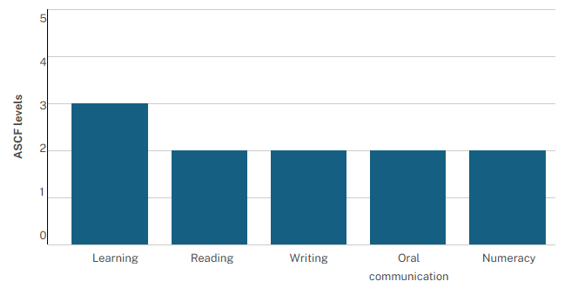
ACSF Level 2 seems very limited. Is this a missed opportunity, especially not raising the numeracy skills to an ACSF Level 3?
One the mandatory units for the UEE22226 Certificate II in Gateway to the Energy Sector qualification is UEEFS2002 Develop foundation skills required for entry to the energy sector. This is an interesting adaptation of units in the Australian VET system. An example about what makes it so interesting is the Knowledge Evidence.
The following is the Knowledge Evidence for the UEEFS2002 Develop foundation skills required for entry to the energy sector unit.
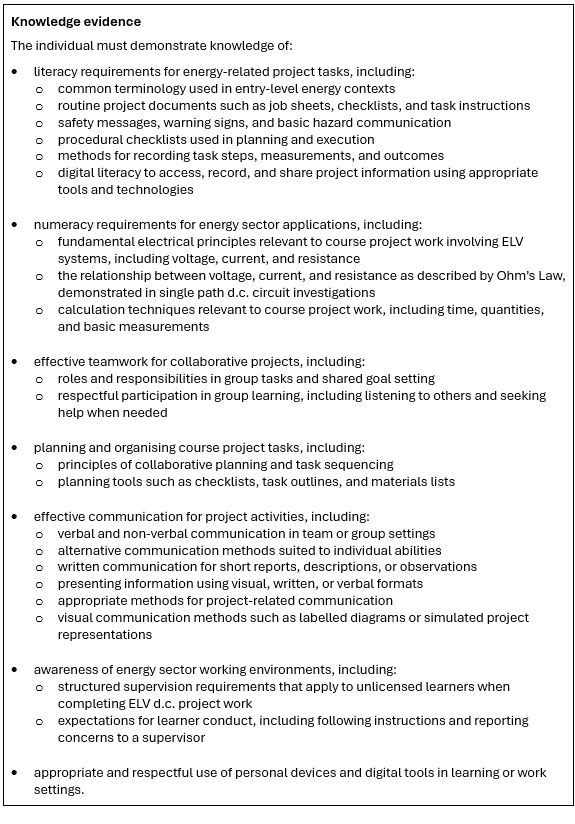
Do all the above items represent knowledge?
The Knowledge Evidence seems like a place to dump information. The UEE units of curriculum are using the Knowledge Evidence as a place to document the details. This is making these UEE units of curriculum very prescriptive. Wasn’t the aim of the new ASK formatted units to make things less prescriptive?
In the past, and currently, the FSK Foundation Skills Training Package separates each foundation skill into a unique unit, but the UEE Electrotechnology Training Package has created a unit that combines all foundations skills into the one unit. This seems to be making ‘super-sized’ units. Yet another innovation for the Australian VET system!
In conclusion
The UEE22226 Certificate II in Gateway to the Energy Sector qualification and associated UEE units using the ASK format are the first to be endorsed and released. There will be a delay before any RTO adds the UEE22226 Certificate II in Gateway to the Energy Sector qualification to their scope of registration. The nominal hours for the new UEE units are not yet available, and RTOs will need to develop their assessment tools and training materials before applying to add the qualification to their scope of registration.
We can expect to have more qualifications and units using the ASK format endorsed and released over the next few months. I’ve reviewed draft ASK units developed by three other JSCs, and each JSC seem to be using the ASK template slightly or extremely different ways to develop new units. It looks like a significant shift from competency-based training to curriculum-based education. And the promise of less prescriptive units seems to have been broken.
Ironically, the new ASK units seem to be more prescriptive while increasing the ambiguity. Generally, we can expect the Australian VET system to become more complex. Is this what our VET leaders want?
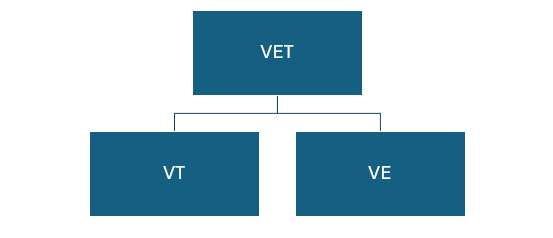
This article has explored a range of initiatives and innovations that relate to the current reforms to the Australian VET system. These VET Reforms include the splitting of VET into two systems:
- A competency-based vocational training system
- A curriculum-based vocational education system.
If you have found this article interesting, thought provoking, or mildly entertaining, please consider ‘liking it’. If not, please ‘share it’ with others so that they may like it.

Do you want more information?
Are you an RTO manager or course coordinator?
Could your RTO team benefit from professional development about changes to the Australian VET system? In particular, how the Training Package Organising Framework or how the new EPC and ASK formatted units impact their work as VET practitioners?

Ring Alan Maguire on 0493 065 396 to discuss.

Training trainers since 1986


