Anyone who knows me, knows that I love PowerPoint. And anyone who knows me, knows that I create PowerPoint presentations to support the delivery of training programs, workshops and webinars.
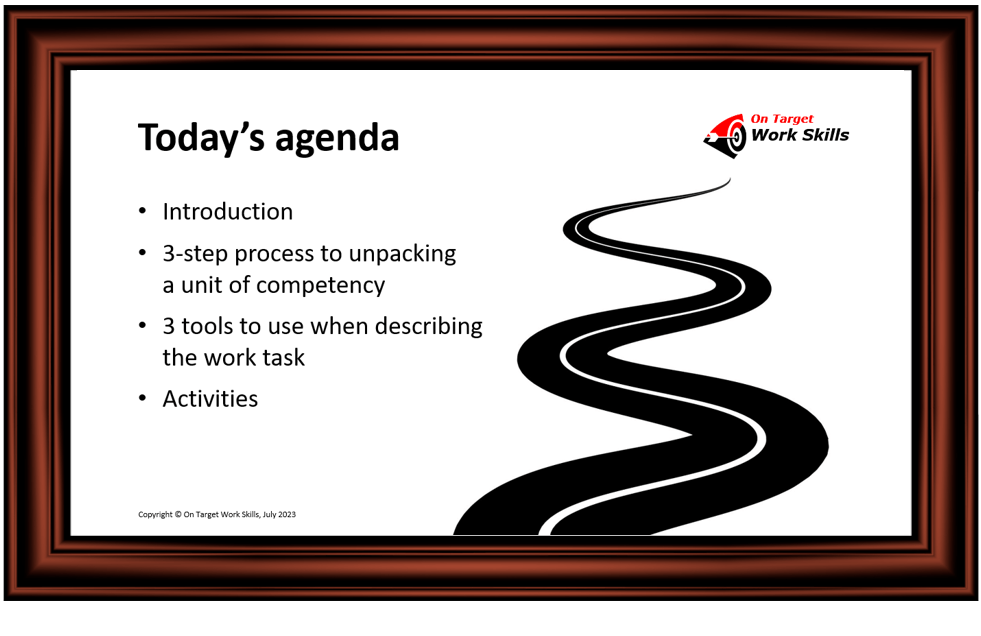
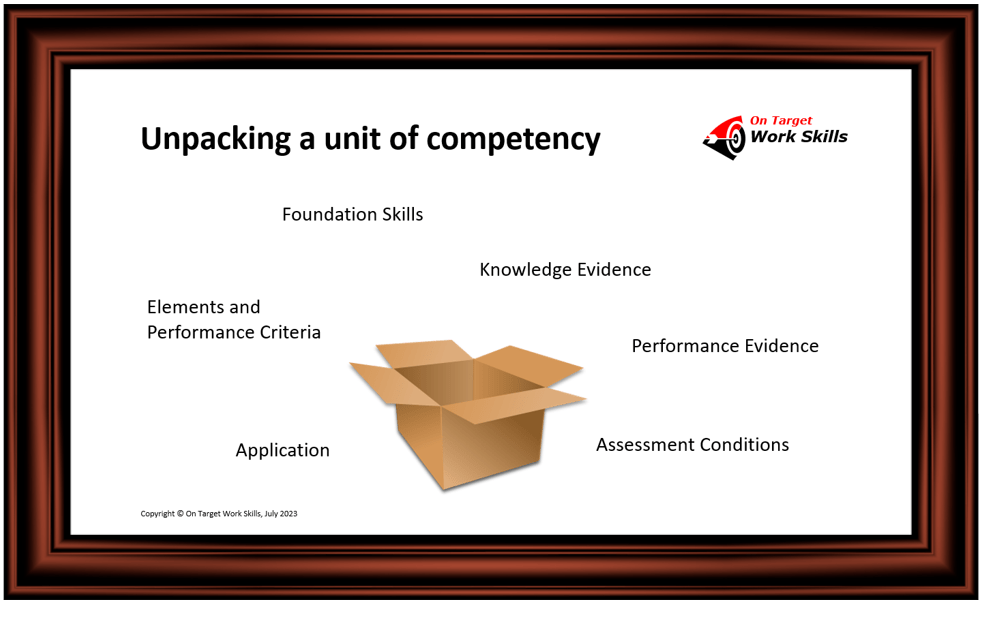
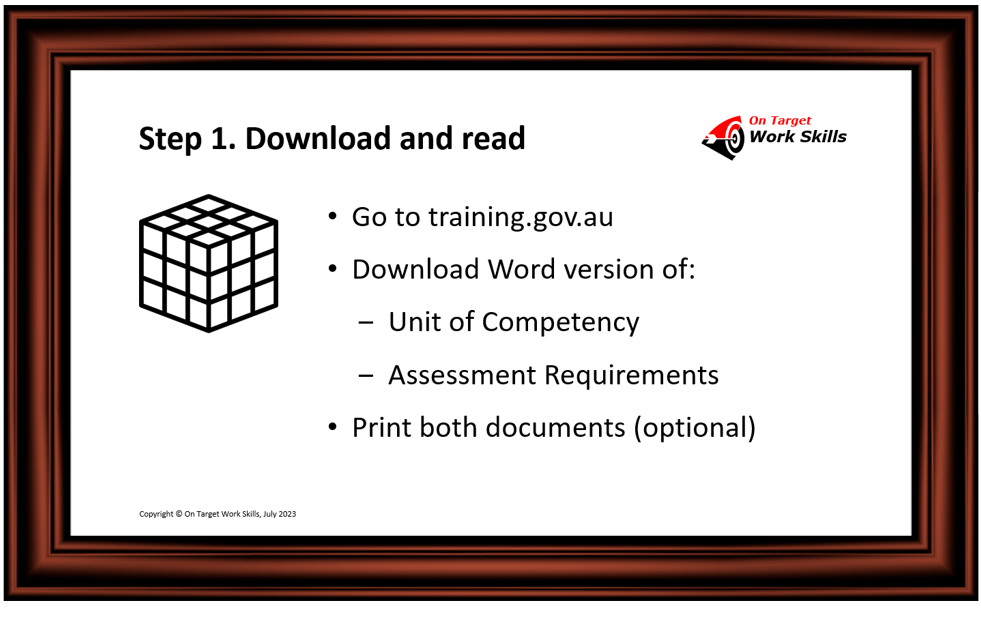
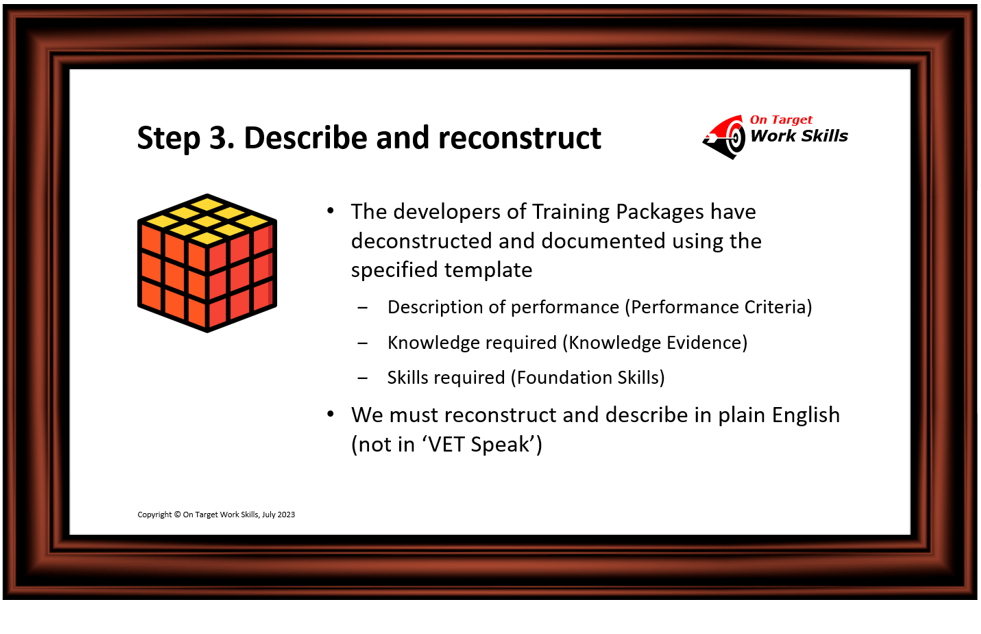
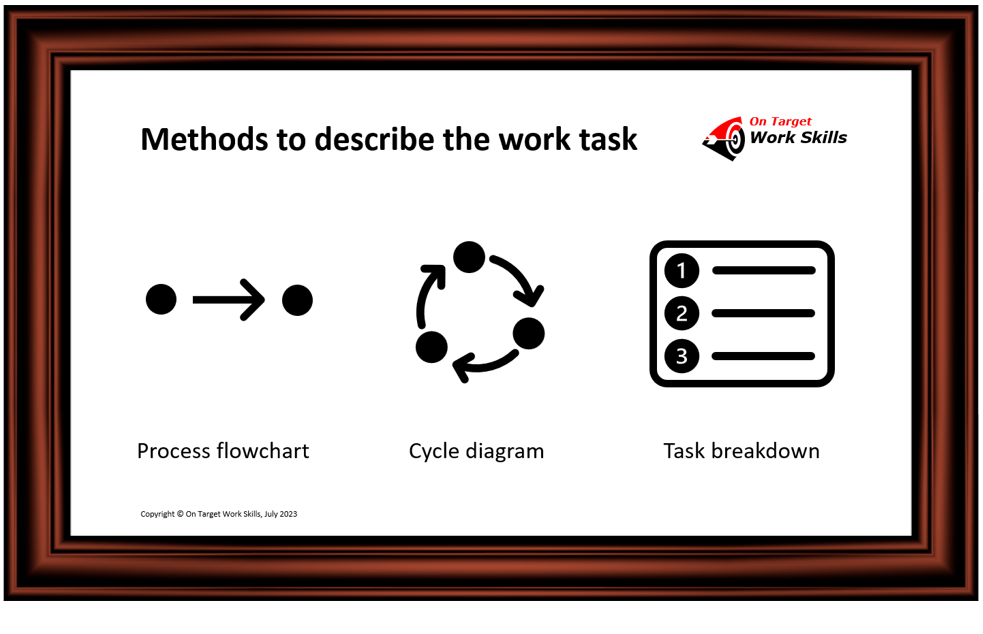
I have recently developed a workshop titled, ‘Unpacking units of competency’. Here is a sneak preview of a selection of PowerPoint slides that I have created for this workshop.
I hope you enjoy having a ‘walk-through this gallery’.
Do you need help with your TAE studies?
Are you a doing the TAE40122 Certificate IV in Training and Assessment, and are you struggling with your studies? Do you want help with your TAE studies?
The TAEASS412 Assess competence unit of competency over-complicates the process of assessing competency. This unit has 6 elements, 31 performance criteria, and 11 foundations skills that are assessable. And many of the performance criteria have been stuffed with details.
This article unpacks the TAEASS412 Assess competence unit of competency, and give a plain and simple explanation of how to conduct competency-based assessment.
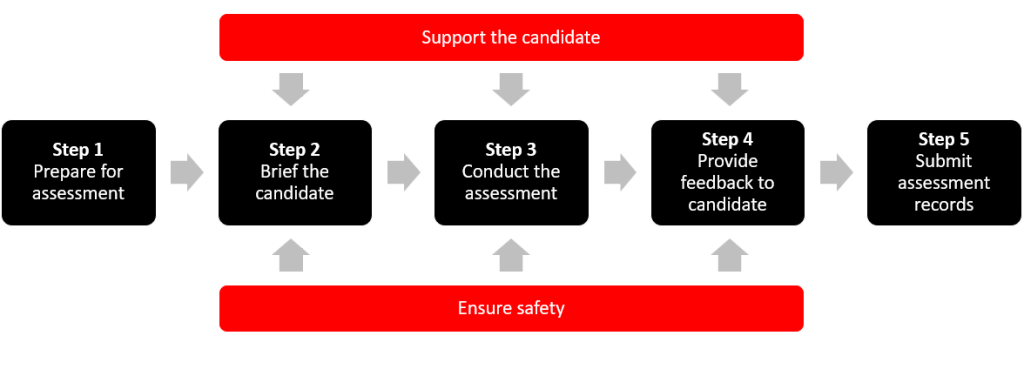
There are five keys steps to assessing competence:
Step 1. Prepare for assessment
Step 2. Brief the candidate
Step 3. Conduct the assessment
Step 4. Provide feedback to candidate
Step 5. Submit assessment records.
Step 1. Prepare for assessment
In theory, information about how the assessment is to be conducted will be in the assessment tool. An assessor should read the assessment tool and identify the following:
assessment methods and assessment instruments to be used
where and when the assessment tasks will be conducted
actions to be undertaken by candidate and assessor in preparation for assessment
facilities, equipment and resources required.
Facilities, equipment and resources required for the assessment may need to be organised or booked in advance.
Step 2. Brief the candidate
The assessor should conduct an assessment briefing to ensure that the candidate is fully aware about:
assessment process and opportunities for re-assessment
standard of performance required to be assessed as competent
where and when the assessment tasks will be conducted
actions to be taken in preparation for assessment
equipment, resources or PPE required
safety precautions, if applicable.
This is the time to confirm that the candidate understands the assessment process and is aware of their right to appeal. It is a good idea to check that the candidate is ready to be assessed.
Step 3. Conduct the assessment
The assessor must ensure that the assessment is conducted according to principles of assessment and rules of evidence. And the assessor must ensure that assessment is conducted safely.
The assessor shall use the assessment instruments from the assessment tool to gather evidence and record their assessment decisions. The assessment decisions must be based on the evidence gathered.
Step 4. Provide feedback to candidate
Provide the candidate with feedback about the assessment outcome and the standard achieved. If required, inform the candidate about the need for re-assessment including what needs to be re-assessed, where the re-assessment will be done, and when it need to be done by.
Step 5. Submit assessment records
The assessor shall complete and submit assessment records and results. Assessment records and results must be kept confidential.
Support and safety
Two of the responsibilities that an assessor has when conducting assessments are:
Support the candidate
Ensure safety.
The following diagram shows the relationship between these two responsibilities and the five keys steps to assessing competence
Support the candidate
The assessor should discuss availability of support when conducting the assessment briefing. The assessor should monitor the candidates progress and determine if any support is needed. And the assessor needs to be available to provide or organise support should it be needed.
Ensure safety
Two types of safety should be considered:
Physical safety
Emotional safety.
It is a good idea to conduct a risk assessment focused on safety before conducting the assessment. Risks may include:
Safety issues relating to the assessment environment
Safety issues relating to the work tasks being performed and assessed
The emotional safety and wellbeing of the candidate.
The assessor must monitor safety throughout the assessment process, and stop the assessment process if there is a potential or actual safety issue.
RTO assessment system
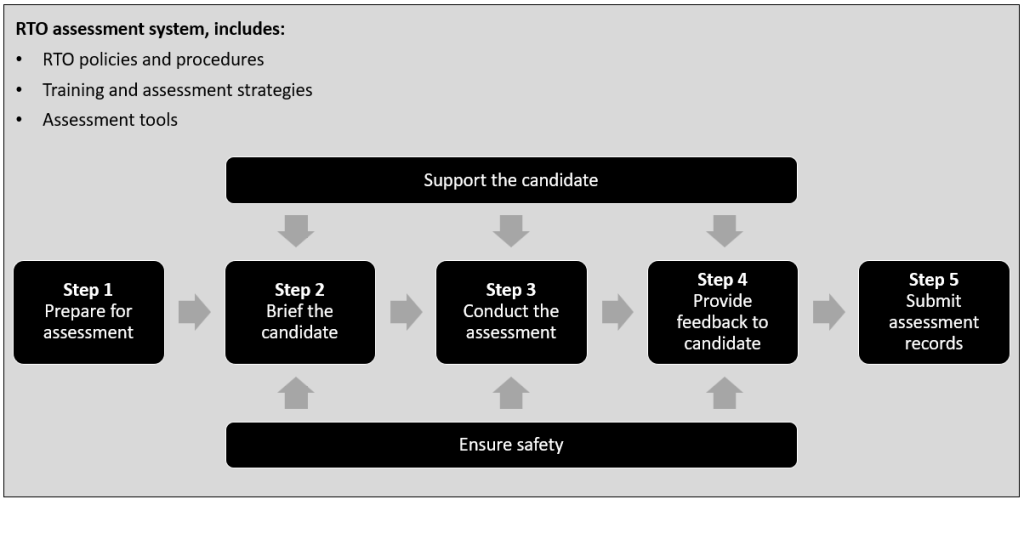
Assessments are conducted within an RTO’s assessment system.
The assessor shall need to read and understand the following documents:
RTO policies and procedures
Training and assessment strategy (TAS)
Assessment tool.
The RTO policies and procedures may include:
Safety
Support arrangements
Record keeping
Privacy and confidentiality
Reasonable adjustment
Appeals and complaints
Assessment review
Assessment validation.
The training and assessment strategy (TAS) should provide an overview about how the assessment is to be conducted. The scope of this document will be a qualification, skill set or stand-alone unit. Examples of units that are delivered as stand-alone include:
First aid
Food safety
Construction induction
Responsible service of alcohol.
The assessment tool should provide the details about how the assessment is to be conducted. The assessment can be for a unit or cluster of units. The assessor must read and understand the assessment tool as a first step to prepare for the assessment. Then, the assessment tool should be used to guide the assessment process. And the assessment instruments are to be used to record gathered evidence and results.
In conclusion
The aim of this article has been to give a plan and simple explanation about how to conduct competency-based assessment. Some TAE Students may be presented with a much more complicated explanation about how to assess competence. If it begins to seem complex or difficult to understand, it would be worth remembering these five steps:
Step 1. Prepare for assessment
Step 2. Brief the candidate
Step 3. Conduct the assessment
Step 4. Provide feedback to candidate
Step 5. Submit assessment records.
Do you need help with your TAE studies?
Are you a doing the TAE40122 Certificate IV in Training and Assessment, and are you struggling with your studies? Do you want help with your TAE studies?
The TAEASS512 Design and develop assessment tools is an elective unit of competency for the TAE40122 Certificate IV in Training and Assessment qualification. This is a great unit for learning about assessment tools. We need to learn about the structure and content of assessment tools. This is important background knowledge for two core activities performed by TAFE teachers and trainers working for an RTO:
principles of assessment and the rules of evidence.
Performance Evidence
The Performance Evidence for the TAEASS512 Design and develop assessment tools unit states that a person must demonstrate their ability to design, develop and document three assessment tools for the assessment of nationally recognised units of competency, including:
at least one assessment tool for a unit of competency packaged in a qualification or accredited course at AQF level 3 or above
at least one RPL assessment tool for a unit of competency packaged in a qualification or accredited course at AQF level 3 or above.
This means that one of the three assessment tools may be for a unit of competency packaged in a qualification or accredited course at any AQF level, including qualification or accredited course that is below AQF level 3.
What is the difference between an assessment tool and RPL assessment tool?
There are two assessment contexts:
training and assessment context
recognition of prior learning (RPL) context.
The ‘training and assessment context’ means that we have delivered training before conducting assessment. The RPL context means that we assess a person’s competency before the training has been delivered.
The template for an RPL assessment tool is usually different than the template for an assessment tool used when conducting assessment after we have delivered the training. This is due to different types of assessment procedures or activities. However, some assessment documents may be the same or similar regardless of the assessment context.
Overview of designing and developing an assessment tool
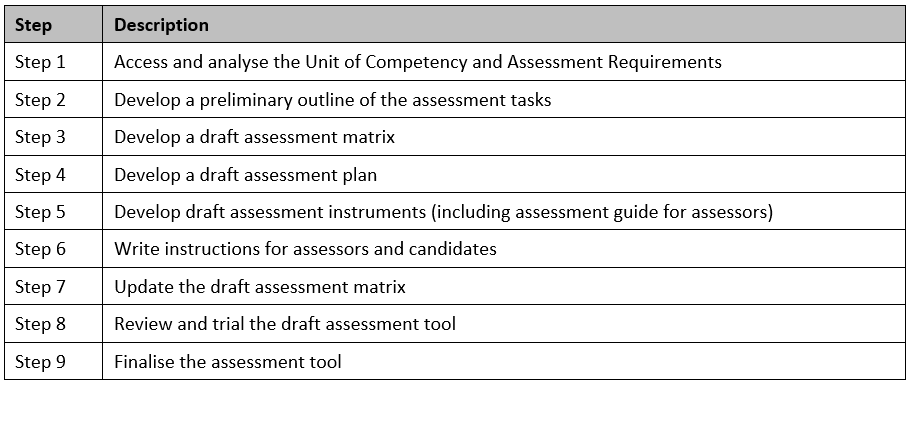
The following nine steps provides an overview of the tasks to be performed when designing and developing an assessment tool.
Step 1. Access and analyse the Unit of Competency and Assessment Requirements
The first step is to access and analyse Unit of Competency and the associated Assessment Requirements to identify what is required to demonstrate competence. The training.gov.au website gives us access the Unit of Competency and Assessment Requirements. These two documents can be downloaded as a Word file or PDF file.
The Unit of Competency and Assessment Requirements will need to be interpreted and contextualised. This may require us to consult with industry and employers
The following questions can help guide our analyse of the Unit of Competency and Assessment Requirements.
What work tasks are to be performed by the candidate?
Is there a volume of performance evidence specified?
How many assessment tasks will be required?
What assessment methods will be used?
Are the assessment conditions specified?
Is the location for the assessment specified?
Are facilities, equipment or resources specified?
Step 2. Develop a preliminary outline of the assessment tasks
This step moves us from analysing to using the information from the Unit of Competency and Assessment Requirements. This is a relatively quick step.
We must use ‘assessment tasks’ to organise our assessment tool. Unfortunately, some RTOs delivering the Certificate IV in Training and Assessment qualification still promote the idea of using ‘assessment methods’ to organise the assessment tool. This is an outdated approach because this is not how we implement assessments. We implement by administrating and conducting assessment tasks.
My first general rule about the number of assessment tasks is that there will always be at least two assessment tasks:
One assessment task to gather the Knowledge Evidence
At least one assessment task to gather the Performance Evidence.
My second general rule about the number of assessment tasks is that we should design our assessment tool to make it easy for assessors to implement and easy for candidates to understand. We should aim to use the least number of assessment tasks as possible, without making the assessment tasks too big or too complicated.
An example
The volume of performance evidence specified for the TAEASS512 Design and develop assessment tools unit of competency is three. It requires the candidate to design and develop three assessment tools. Therefore, we can plan to use four assessment tasks for this unit:
One assessment task to gather the Knowledge Evidence
Three assessment tasks to gather the Performance Evidence.
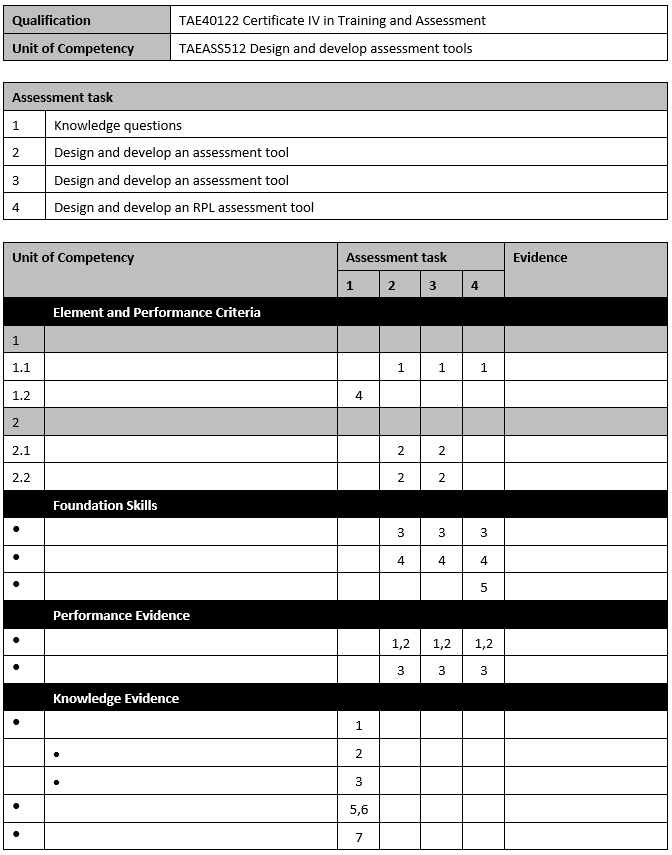
The following is a preliminary outline of the assessment tasks for the TAEASS512 Design and develop assessment tools unit of competency.
The preliminary outline of the assessment tasks is a starting point. We may need to change the assessment approach as we design and develop the assessment tool.
Step 3. Develop a draft assessment matrix
An assessment matrix may also be known as ‘assessment mapping’ or ‘competency map’.
This step relates to the development of draft assessment matrix that includes an outline of the evidence to be gathered from a candidate. At this stage, we use an ‘x’ to link the specifications of the Unit of Competency and Assessment Requirements with the assessment tasks. The assessment matrix is an important part of the assessment tool. It is used to design for compliance and check for compliance. The following is my recommended template for an assessment matrix. It has a column on the right that is used to document the evidence to be gathered from a candidate.
The draft assessment matrix is updated with details after the assessment instruments have been developed (Step 7).
Steps 4, 5 and 6
Steps 4, 5 and 6 covers the development of the assessment tool.
Step 6. Write instructions for assessors and candidates
The assessment matrix is part of the assessment tool, and it is used to guide the development of the remaining documents. RTOs will usually have templates for these documents, and TAE Students will be provided with templates.
The development of the draft assessment instruments and criteria to be used to make judgements about whether competence has been achieved can be time-consuming. And when we develop the assessment tools, it is important to number assessment items. For example:
Number each question
Number each item on an observation checklist
Number each item on a product review checklist
Number each item on a third-party report.
The ‘assessment guide for assessors’ may also be known as a ‘marking guide’. The purpose of this document is to support reliable assessment (one of the four principles of assessment). The assessment guide should include:
Sample answers for the questions being used to gather the Knowledge Evidence
Criteria for making decisions relating to the standard of Performance Evidence gathered.
Step 7. Update the draft assessment matrix
After the assessment instruments have been documented, we update the assessment matrix with reference to the numbering of each assessment item (see above). The following illustrates an updated assessment matrix that was originally created in Step 3.
Step 8. Review and trial the draft assessment tool
Some people may call this step the pre-validation of an assessment tool. It consists of two different activities:
Review of the draft assessment tool
Trial of the draft assessment tool.
These activities will involve others. We need a person or people who have not been involved with the design and develop of the assessment tool to look at what we have created with fresh eyes. And we them to use the assessment tool to find out if it can be understood and implemented from the perspective of an assessor and candidate.
We can identify what needs to be fixed or areas for improvement by observing the assessment tool being used by others. Also, we should seek feedback from the person or people who have been involved in the review and trail of the assessment tool.
Step 9. Finalise the assessment tool
We finalise the assessment tool based on the feedback gathered during the review and trial of the draft assessment tool.
A useful guide to assessment tools
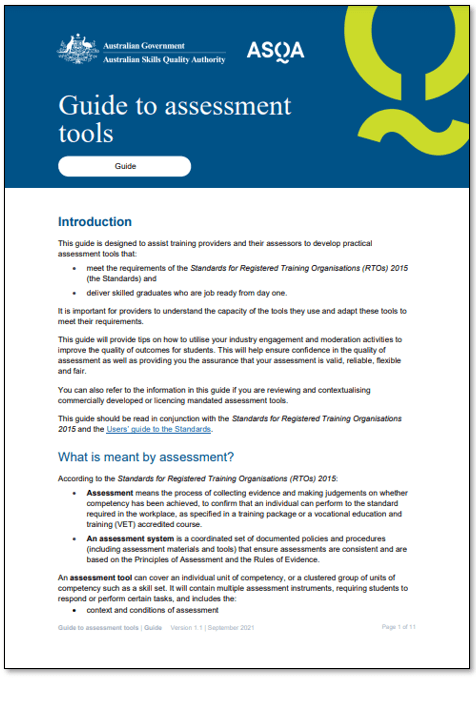
ASQA has published a document titled, Guide to assessment tools. This is a relatively short document that is reasonably easy to read. It is a document that covers important information about designing and developing compliant assessment tools. And it provides practical information and ideas.
In conclusion
It takes time and effort to design and develop an assessment tool that is compliant and works for the assessor and candidate. It regards to time, it can take days. This article has provided a 9-step process that is methodological and practical.
Many TAE Students find the TAEASS512 Design and develop assessment tools unit of competency a bit challenging for a range of reasons, including:
Unclear or confusing instructions
Badly designed templates
Templates that are difficult to use or modify
No examples of completed templates provided
Examples of completed templates are confusing
Insufficient time allocated to the provision of training
The learning resources are poorly written or lack required content
The TAE Trainer is unable to explain or demonstrate what needs to be done.
Also, the TAEASS512 Design and develop assessment tools unit of competency has a large number of specified Knowledge Evidence items (41 bullet and sub-bullet points). A TAE Student must expect this unit of competency to take a lot of time and effort to complete, and it may be challenging, confusing and frustrating.
Do you need help with your TAE studies?
Are you a doing the TAE40122 Certificate IV in Training and Assessment, and are you struggling with your studies? Do you want help with your TAE studies?
Digital devices have changed our approach to reading and content consumption, with a significant shift towards on-screen reading over traditional paper formats. This has resulted in a continuous expansion of learning and assessment resources presented on digital platforms.
As trainers, TAFE teachers, or educators, it is imperative for us to comprehend the evolving reading behaviours of individuals and be mindful of the manner in which we present instructions and information to learners.
The importance of reading
Reading plays a vital role in the learning journey, and the way learners read in the digital age greatly impacts their learning outcomes. Perspectives on the subject differ, with some asserting that screens enhance the reading experience, while others argue that on-screen reading is less than ideal and may diminish attention spans.
Short attention span
In general, individuals who read on screens tend to prefer shorter texts as they struggle to sustain their attention for longer than a minute. For some readers, their attention span may be as short as 10 seconds or even less. Consequently, the limited reading time results in a reduced amount of content being absorbed.
Non-linear reading
On-screen text often incorporate hypertext, promoting a non-linear reading approach. Users can conveniently click or tap on links without necessarily completing a paragraph, let alone an entire page. This reading behaviour often results in browsing, scanning, keyword spotting, and engaging in one-time or partial reading. Consequently, non-linear reading reduces the amount of time dedicated to comprehensive and focused reading.
Skim, scan and skip
Many readers do not complete lengthy on-screen documents, nor do they scroll down the page. Instead, they tend to skim, scan, and skip through most sections. However, people tend to do more ‘picture’ reading, where individuals look for graphs, charts, and illustrations that visually aid their understanding of a topic.
In conclusion
Here are four techniques we can use to present content for effective on-screen reading:
Use explanatory subheadings
Keep paragraphs short and sentences simple
Use lists to organise content, enabling quick and easy access
Use images to grab the reader’s attention and keep them interested.
And finally, when presenting on screen content, we need to continuously seek opportunities to grab learners’ attention and maintain their interest. Can you think of some ways for capturing learners’ attention and sustaining their interest?
(Using questions is one technique we can use to engage the learner and maintain their interest.)
Do you need help with your TAE studies?
Are you a doing the TAE40122 Certificate IV in Training and Assessment, and are you struggling with your studies? Do you want help with your TAE studies?
The Certificate IV in Training and Assessment qualification requires the design and development of documents for trainer-led training. It can be for an individual or a group of learners. The design and development of self-paced online training is an advanced skill that is covered by the Diploma of Vocational Education and Training qualification.
This article explore the design and development of documents for trainer-led training.
The current TAE40122 Certificate IV in Training and Assessment qualification has core units of competency that require the design, development, and customisation of training documents. These units are:
The following requirements are specified in the TAEDES412 Design and develop plans for vocational training unit of competency.
Element 2. Design a plan for vocational training The performance criteria for Element 2 specifies that this training delivery plan shall include:
overall plan and structure
duration of training
sequence of delivery
learning activities
learning resources.
Element 3. Develop session plans for vocational training The performance evidence for this unit specifies that this training session plan shall include:
learning objectives
presentation methods
learning activities
formative assessment activities
sequence and timing of activities within a session
required resources
total duration of the session.
The TAEDES412 unit required the development of training delivery plans and training session plans.
This raises the question, ‘What is the difference between a training delivery plan and a training session plan?’ A delivery plan describes the plan to deliver all the training for a unit or a cluster of units. It takes many training sessions to cover the training for one unit of competency. A session plan describes in more details a plan for how each training session is delivered.
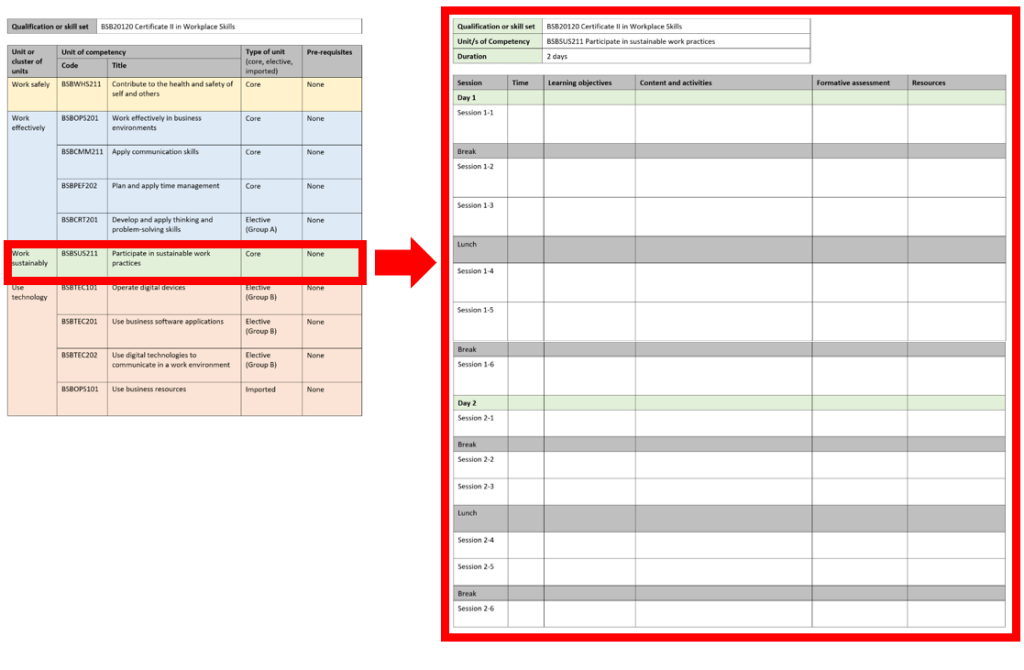
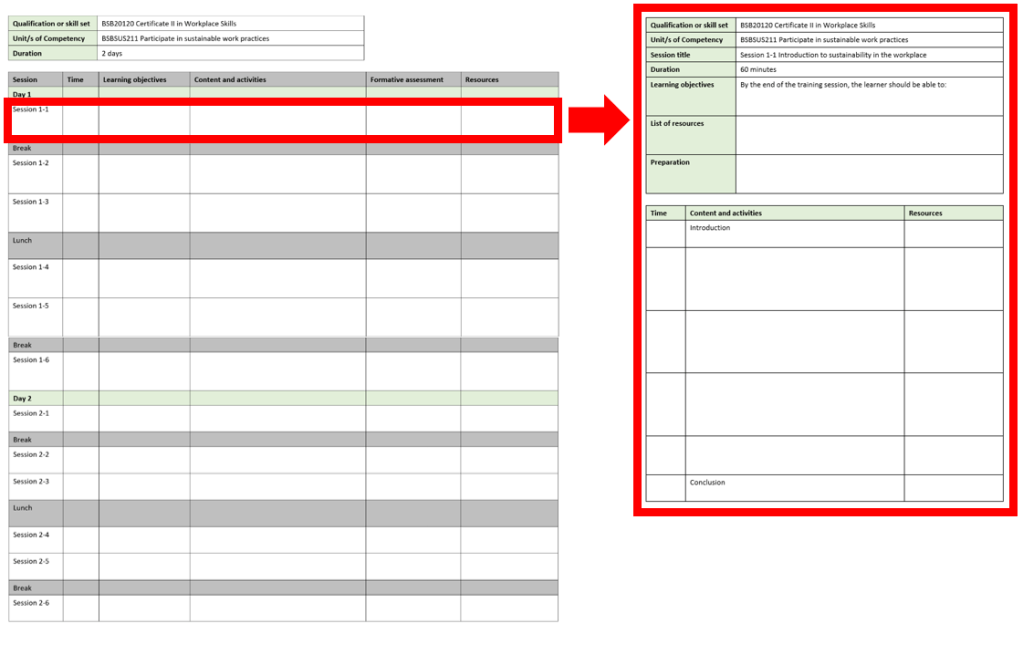
The following illustrates how a training delivery plan describes the training for an entire unit. And a session plan describes the training for a part of the unit.
In the above example, the training has a 2-day duration with a total of 12 training sessions (6 sessions on each day). Therefore, this is an example when there would be one training delivery plan and 12 training sessions plans.
What is specified by the TAEDEL411 unit?
The following requirements are specified in the TAEDEL411 Facilitate vocational training unit of competency:
Performance criteria 1.3 Arrange and review delivery plan, session plans and learning resources according to legislative and regulatory requirements
Performance criteria 2.2 Customise session plans and learning resources to suit learners and their context
These performance criteria make reference to:
delivery plan
session plans
learning resources.
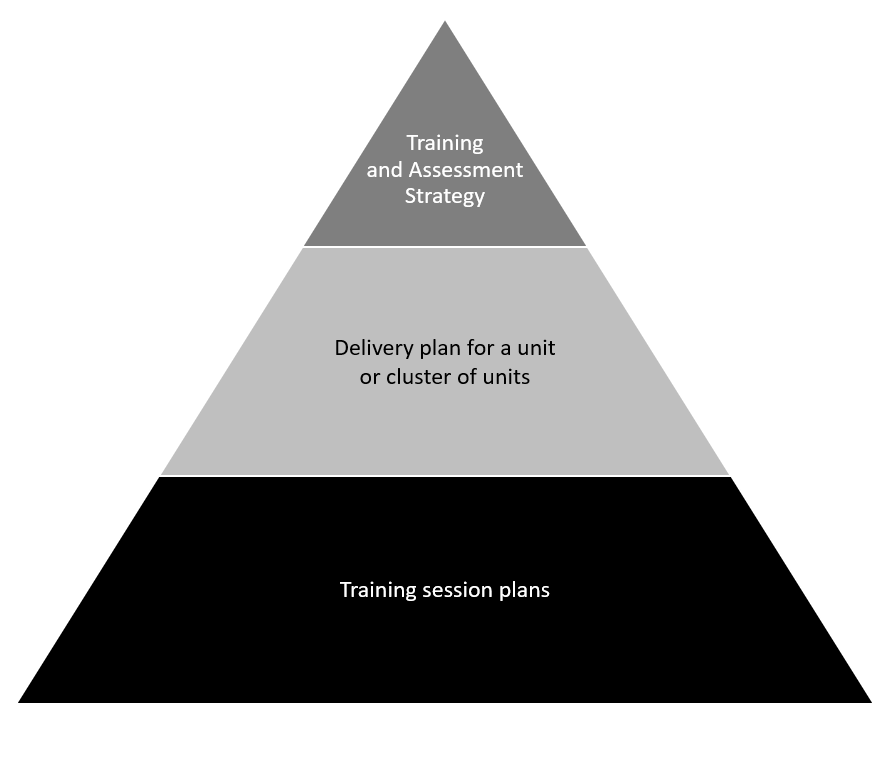
The following diagram shows the relationship between the various training documents frequently used in Australia’s VET system.
Clause 1.1 of the Standards for RTOs 2015 requires an RTO to develop a training and assessment strategy for every training product on the RTO’s scope of registration. [1] The design and development of a training and assessment strategy is an advanced skill that is covered by the Diploma of Vocational Education and Training qualification.
What is the difference between a training and assessment strategy, training delivery plan, and training session plan?
The requirements for an RTO’s Training and Assessment Strategy (TAS) are specified in the Standards for RTOs 2015, and the Users’ guide to the Standards for RTOs 2015 provided additional information. It shall identify the units of competency to be delivered for the qualification or skill set. The following is an example of 10 units of competency identified for a qualification (taken from the TAS). The details for delivering each unit or cluster of units may be documented in a training delivery plan. This example is for one unit.
The next layer of documents are training session plans. The following is an example of a training delivery plan consisting of 12 sessions. The details for delivering each session may be documented in a training session plan. This example is for one session.
The details have not been included in the above examples, so as to keep it easier to comprehend. Typically, a TAS is a document that may be a 10 or more pages. Typically, a training delivery plan may be 5 or more pages (depending on the number of units and number of days). And typically, a training session may be a 2 or 3 pages.
In conclusion
A Training and Assessment Strategy is a document that describe how a training product, such as a qualification or skill set, is planned to be delivered. A delivery plan is a document that describes how training for a unit or cluster of units is planned to be delivered. And a session plan is a document that describes how a training session is planned to be delivered.
An RTO will usually have templates for documents that it requires to be developed, such as:
If you are a TAE Student, you will usually be given templates to be used for developing training delivery plans and training session plans.
Are you a doing the TAE40122 Certificate IV in Training and Assessment, and are you struggling with your studies? Do you want help with your TAE studies?




















 On Target Work Skills