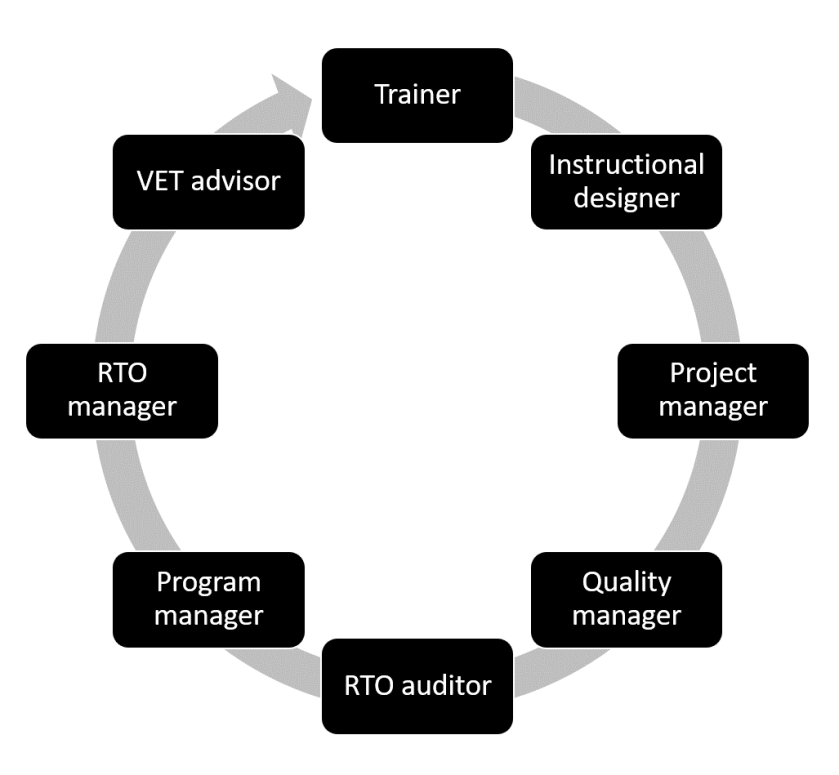
40+ years experience as a trainer, instructional designer, quality manager, project manager, program manager, RTO auditor, RTO manager and VET adviser.
Two new TAE qualifications were approved by the Australian Industry Skills Committee (AISC) on the 8th of November 2022 and endorsed by Skills Ministers on the 18th of November 2022.
The two new TAE qualifications are:
TAE40122 Certificate IV in Training and Assessment (to replace the TAE40116 Certificate IV in Training and Assessment)
TAE50122 Diploma of Vocational Education and Training (to replace the TAE50116 Diploma of Vocational Education and Training and TAE50216 Diploma of Training Design and Development)
This article is focused on the TAE40116 Certificate IV in Training and Assessment, and its replacement.
TAE40116 Certificate IV in Training and Assessment
The TAE40116 Certificate IV in Training and Assessment has probably been the most hated qualification in the Australian VET system of all time. However, I am one of the few people that thought it was a reasonable qualification that had been designed for people wanting to enter the VET workforce as a trainer and assessor. But it does not matter what I think because many others loudly complained about the TAE40116 qualification.
Complaints included:
The TAE40116 qualification was not fit-for-purpose.
Irrelevant Units of Competency were included.
The TAEASS502 Design and develop assessment tools is a core unit for the qualification and it was too difficult for many TAE Students.
Sometimes it was difficult for TAE Students to assemble at least 8 people to be an audience for their group-based training sessions.
Some topics were not being covered.
In regards to this last complaint, many topics were covered by the Units of Competency but some RTOs delivering the TAE40116 qualification do not allocate training time to cover these topics. The problem was not with the design of the TAE40116 qualification. The problem was the way RTOs delivered their training programs.
TAE40122 Certificate IV in Training and Assessment
The TAE40122 qualification has done nothing to address the complaint that the Certificate IV in Training and Assessment is not fit-for-purpose. The qualification continues to be for entry-level VET teachers, trainers and assessors who will work for an RTO. Nothing has changed. Therefore, this complaint about the qualification being not fit-for-purpose is likely to continue into the future.
The TAE40122 qualification has increased the number of Units of Competency, from 10 units to 12 units. This increases the amount of assessments to be completed and increases the chances of irrelevant units needing to be delivered as part of the qualification. There are a range of units that many TAE Students will continue to find difficult, and many units have additional complexity. Therefore, the complaints about irrelevant and difficult units are likely to continue into the future.
The number of people needing to be assembled for delivery group-based training sessions has been reduced, from 8 people to 4 people. I am surprised that RTOs employing new TAE Graduates have thought that delivering 30-minute training sessions to 4 people was reflective of typical workplace requirements. Anyway, this requirement makes it easier for RTOs delivering the Certificate IV in Training and Assessment. Therefore, the complaints from RTOs delivering the Certificate IV in Training and Assessment should reduced. However, will RTOs employing new TAE Graduates be satisfied with the capabilities of new TAE Graduates? Will the complaints by RTOs employing new TAE Graduates increase?
Many TAE Students are dissatisfied with the way their TAE40116 Certificate IV in Training and Assessment qualification is delivered.
Overloaded with terminology and jargon
Complicated assessment instructions
Poor quality training materials
Limited or no training, or the pace is too fast
Poor quality trainer, or change of trainer because previous trainer leaves
Slow or no feedback, or feedback that is difficult to decipher.
Will RTOs delivering the TAE40122 Certificate IV in Training and Assessment qualification improve the quality of their training and assessment service? Time will tell. However, the additional complexity of some units is likely to make the TAE40122 qualification more difficult for the TAE Students. The duration of the TAE40122 qualification is likely to increase, and the cost may increase. Therefore, the complaints about the Certificate IV in Training and Assessment are likely to continue.
Do you need help with your TAE studies?
Are you a doing the TAE40122 Certificate IV in Training and Assessment, and are you struggling with your studies? Do you want help with your TAE studies?
I feel privileged to have had a brilliant career in vocational education and training (VET), and it is not over yet. After 35 years of working in VET , I felt that it was time to reflect on the path I’ve travelled.
My career has not been built on academic achievement or the attainment of qualifications. It has been built on making the most of opportunities, a strong work ethic, and the accomplishment of goals. I have worked as a trainer, instructional designer, project manager, quality manager, RTO auditor, program manager, RTO manager, and VET adviser.
Trainer
I was given structured training in how to train people while serving in the Australian Army Reserves during the early 1980s. At that time, I was working for Telecom Australia as a sales and customer services officer. And in 1986, I commenced working as a full-time role-model instructor. This job was for delivering sales, customer service, and product knowledge training.
As part of the selection interview process, I was required to deliver a mock training session. I was able to demonstrate good training structure, good interpersonal and communication skills, good use of training aids, good questioning techniques, etc. because of my previous training and experience in the Australian Army Reserves. The members of the selection panel were impressed. They asked if I could also deliver ‘Train-The-Trainer’, and I said yes.
A condition of employment as a full-time trainer was to undergo an accreditation process. Our performance as a trainer was observed by the training manager. An observation checklist covering a range of performance criteria was used. The following photo shows me and work colleagues graduating in 1996 as ‘accredited’ trainers.
For two years, I delivered sales and customer services training, product knowledge training (specialising in business phone systems), and trainer training. Also, I was involved in the design and development of these training programs.
I discovered a passion for reading non-fiction books about personnel effectiveness and training. Two books that influenced me in my early days as a trainer were:
How to be an effective trainer by Barry Smith and Brian Delahaye gave me the basics
The Winning Trainer by Julius Eitington gave me the insight into advanced facilitation skills
It was a privilege to have been given the opportunity to deliver the Train-The-Trainer training course to Victorian trainers employed by Telecom Australia. It allowed me to learn more deeply about how to design, develop, deliver, and evaluate training. And as a young person, in my mid-20s, I had found my vocation. It was at this time that I decided that ‘training’ would be my career.
Instructional designer
In 1988, I was promoted to the position of instructional designer. I was developing competencies and designing training programs for Telecom Australia’s national salesforce. Some influencers on me and my work were:
Dick and Carey’s systematic approach to instructional design
Donald Kirkpatrick’s four levels of training evaluation
John Keller’s ARCS model of motivational design
Telecom Australia’s Vision 2000 program
AT&T’s approach to training.
I became an avid listener to audio cassettes, especially when driving my car. Zig Ziglar, Denis Wailey, Tom Peters, Tony Robbins, and Stephen Covey were some of the people I would frequently listen to. I was constantly getting great information and positive ideas that I could implement.
I joined the Australian Institute of Training and Development (AITD) in 1989. First, I was chair of the membership committee and we introduced the AITD professional grading scheme. Then, I become treasurer and vice president of the Victorian Division, followed by acting as the president at a turbulent time when the Australian Human Resources Institute (AHRI) tried to takeover the AITD in the early 1990s. Founding members of the AITD become extremely active and the takeover was blocked. I learnt many things during this time including how to manage the proceedings at hostile meetings. Also, for a brief time, I was an AITD national director representing the Victorian Division.
In 1992, I was on a committee that reviewed the first competencies for Australian trainers: Category 1 and Category 2 for Workplace Trainer. This was at the beginning of today’s competency-based training and assessment system in Australia.
And it was the dawning of the ‘New Age’, and I become fascinated by accelerated learning methods and neuro-linguistic programming (NLP). This was a good excuse to increase my repertoire of training methods: more games, more fun, more butchers paper, more colour, mind maps, playing baroque and New Age music, meditations and self-reflections. But I should note that there can be a dark side to these powerful training methods.
Innovation and quality
In 1993, I was promoted to a role with the responsibility for conducting research and implementing innovation throughout Telstra’s training services. This included investigating and developing a range of training technologies and methodologies. It was great being at the leading edge of computer-based learning, learning management systems, learning centres, and using video conferencing for delivering training.
Also, this was at the time when there was a focus on improving quality. I had the opportunity to develop a quality management system for Telstra’s national training design and delivery unit. I continued to be an avid reader, and my learning and self-development was influenced by:
ISO9001:2000 Quality management systems and associated standards
The Team Handbook by Peter Scholtes and other contributors
Improving Performance by Geary Rummler and Alan Brahe
Kepnor Tregue’s project management methodology and tools.
During the mid-1990s, I discovered a little book that had been written by Malcolm Knolwes about 20 years earlier. This book’s title is, Self-directed learning: A guide for learners and teachers. For me, although small in size, this book contains important ideas about facilitating adult learning. Many people do not buy books these days. However, the internet has much information about andragogy, self-directed learning, and how self-directed learning can be applied in the digital age.
At this time, I was part of the management team, and my manager reported to the senior executive who reported directly to Telstra’s CEO. My work opportunities allowed me to hone my skills at operating professionally, and producing documents to the highest levels of corporate standards.
Project manager
Between 1997 to 2001, I was a senior project manager with the responsibly to lead some significant strategic projects, such as:
Design, development and implementation of training programs for engineers, technicians, and sales staff for Telstra’s first broadband internet service
Design, development and implementation of Telstra Values training program that had a target audience of more than 45,000 executives, managers, and employees across Australia and overseas.
RTO auditor
After 21 years in Telstra Corporation, I made my way to TAFE. I started working as an internal auditor and quality management consultant at Holmesglen Institute (of TAFE). My role as an RTO auditor allowed me to learn about VET compliance and the delivery of nationally recognised training for a wide-range of industry sectors.
Program manager
After a couple years at Holmesglen Institute, I was promoted into a commercial area with the responsibility to manage various programs, including traineeships.
Then, I moved from TAFE to Master Builders Association (of Victoria). And I had the responsibility for builder registration, management, leadership and other training programs relating to the building and construction industry.
RTO manager
From Master Builders, I moved to the Housing Industry Association as the training manager. During this time I had to opportunity to apply my capabilities at management, team leadership, compliance, establishing a budget and training calendar.
VET advisor
From the Housing Industry Association , I moved to the Australian Industry Group. During this time, I represented the education and training needs of industry and employers on a range of committees and working groups, including:
Represented industry on the FDF Training Package industry reference committee
Represented industry on the Australian Government’s National VET E-learning Strategy
Represented industry on Victorian industry training advisory boards (ITABs)
Represented industry on Victorian accredited and re-accredited courses committees
Represented industry on the committee that developed the Australian Government’s ‘Preparing Secondary Students for Work: A framework for vocational learning and VET delivered to secondary students’
Participated at federal and state minister roundtables.
My work covered such things as reforms to the VET system, apprenticeships, and VET in Schools. Also, I conducted training needs analysis for businesses seeking government funding from the Industry Skills Fund.
Training trainers
I started training trainer in 1986. Since then, I have trained countless number of trainers to become qualified. I have delivered the following:
TAA40104 Certificate IV in Training and Assessment
TAE40110 Certificate IV in Training and Assessment
TAE40116 Certificate IV in Training and Assessment
21697VIC Diploma of Vocational Education and Training Practice
TAA50104 Diploma of Training and Assessment
TAE50116 Diploma of Vocational Education and Training
It has been a privilege to work for industry associations, employer and employee associations. It has been a privilege to have been a part of the Australian VET system (be it a small part).
I have had military experience. I have worked for major corporations. I have worked for several TAFEs, and several private RTOs. I have worked for several industry associations. I have worked for employer and employee associations. And now I operate my own microbusiness.
My brilliant career
I feel that I have had a brilliant career in VET. And it is not over yet.
I am working towards leaving a legacy. Recently, my goal has been to design and develop the best training and assessment resources for the delivery of Certificate IV in Training and Assessment qualification. And I am regularly publishing information and ideas about VET from my On Target Work Skill website.
After 35 years experience, I feel privileged to be able to help the next generation of trainers to enter the VET workforce. It may seem that I have returned to where I had begun – as a trainer. But I am a better trainer now because of the vast experience that I have had.
Also, I have taken on a new role – as a tutor. I have established a TAE Tutoring service to help individuals who are struggling with their TAE studies. Many people can find that the Certificate IV in Training and Assessment qualification is difficult and they need assistance that their RTO is unable to provide.
The moral to my story is that it is possible to create your own career pathway based on work experience rather than the attainment of qualifications. My career progression has been based on a willingness to learn while working. The workplace is a great place to learn.
I am grateful for the opportunities that I have had. And I am looking forward to the future as I continue to learn more, do more, and share more.
The Australian competency-based VET system defines competency as the consistent application of knowledge and skills to the standard of performance required in the workplace. [1]
This definition highlights the importance of skills and knowledge as foundations for effective performance at work.
Two types of foundation skills
The Australian VET system has two types of foundation skills:
Foundation skills from the FSK Foundation Skills Training Package
Foundation skills for each Unit of Competency
Foundation skills from the FSK Foundation Skills Training Package
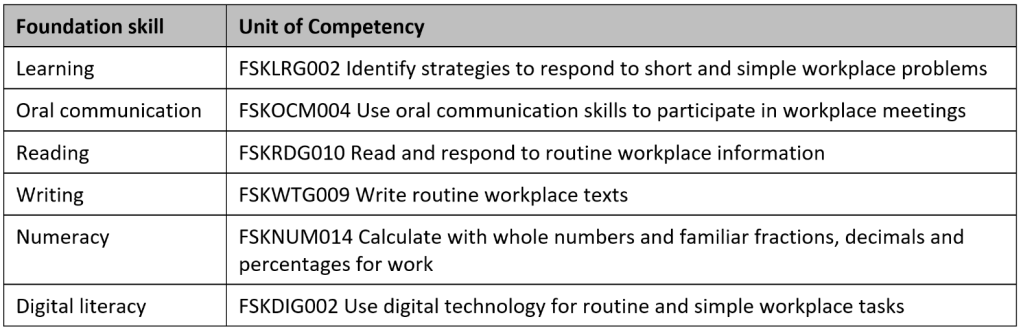
The FSK Foundation Skills Training Package describe the skills and knowledge that underpin vocational performance. It provides an opportunity for registered training organisations (RTOs) to select and deliver foundation skills units and qualifications that will enable learners to build the specific foundation skills required to achieve vocational competency. [2]
The following are four units of competency from the FSK Foundation Skills Training Package:
The above examples shows how the FSK units of competency focus on the development of learning, reading, writing, oral communication, and technology skills at a really low level.
Foundation skills for each Unit of Competency
Foundation skills are described or implied within all units of competency in the Australian VET system. These are the focus of this article, covering:
A brief history of foundation skills
Integration of foundation skills
Integration of knowledge
Putting it all together
Examples are provided throughout this article. Please prepare yourself for a long but informative read.
A brief history of foundation skills
It has been 30 years since Australia commenced the implementation of the competency-based VET system that operates today (this article was published in 2022). At the very beginning, there was a recognition that skills were needed to perform work tasks, and it wasn’t just about having the technical skills. Non-technical skills, such as communication skills and other generic skills, were recognised as being essential for effectiveness in the workplace.
1992
In 1992, a committee, chaired by Eric Mayer, released a report that identified the generic skills needed for effective participation in future work. Isn’t it interesting that the requirements for ‘future work’ was being considered many decades ago. Both ‘generic skills’ and ‘technical skills’ were seen as necessary for a person to have the capability to perform work tasks. These employment-related generic skills became known as the Mayer Key Competencies.
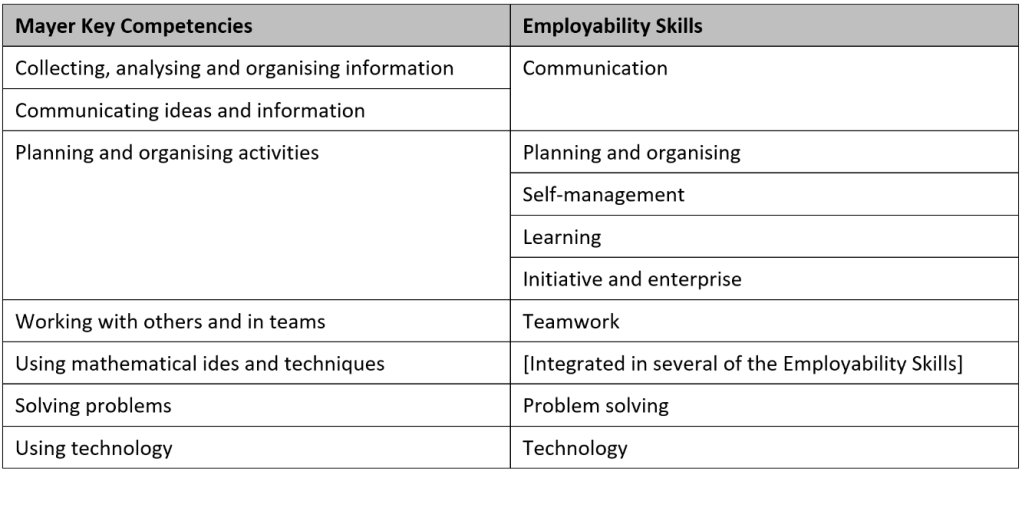
The seven Mayer Key Competencies were:
Collecting, analysing and organising information
Communicating ideas and information
Planning and organising activities
Working with others and in teams
Using mathematical ides and techniques
Solving problems
Using technology
The Mayer Key Competencies were integrated explicitly and systematically with technical competencies. The first Training Packages contained information about how the Mayer Key Competencies related to each Unit of Competency.
There were three key competency levels that related to effective workplace practices:
Level 1 where work is within set conditions and process
Level 2 where the management or facilitation of conditions or process is exercised
Level 3 where the design and/or development of conditions or process is required.
The following is an example of the Mayer Key Competencies for the BSZ407A Deliver training session unit of competency (initially released in 1998).
Many trainers found the Mayer Key Competencies difficult to understand and difficult to integrate when delivering training. A number assigned to each of the seven key competencies lacked information to be useful.
2002
In 2002, the Australian Chamber of Commerce and Industry (ACCI) and the Business Council of Australia (BCA) released a publication titled, ‘Employability skills for the future’. This publication presented eight generic competencies as an alternative to Mayer Key Competencies. These became known as the Employability Skills.
The following table compares Mayer Key Competencies with the Employability Skills.
The Employability Skills replaced Mayer Key Competencies in Training Packages. The Employability Skills were described for each qualification and explicitly embedded in units of competency.
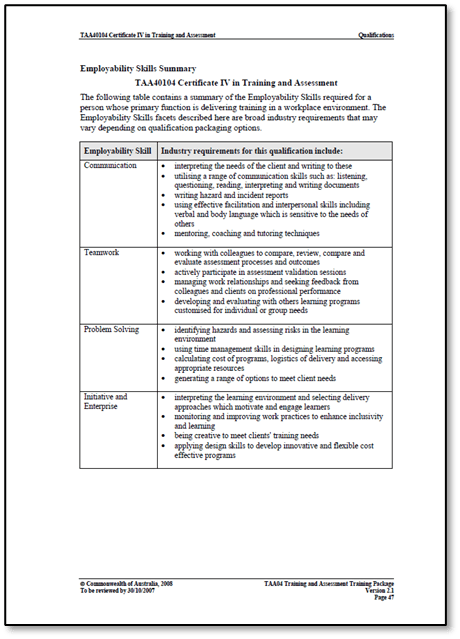
Employability skills for a qualification
The following two pages is an example of Employability Skills being described for the TAA40104 Certificate IV in Training and Assessment qualification (initially released in 2004).
Employability skills embedded in units of competency
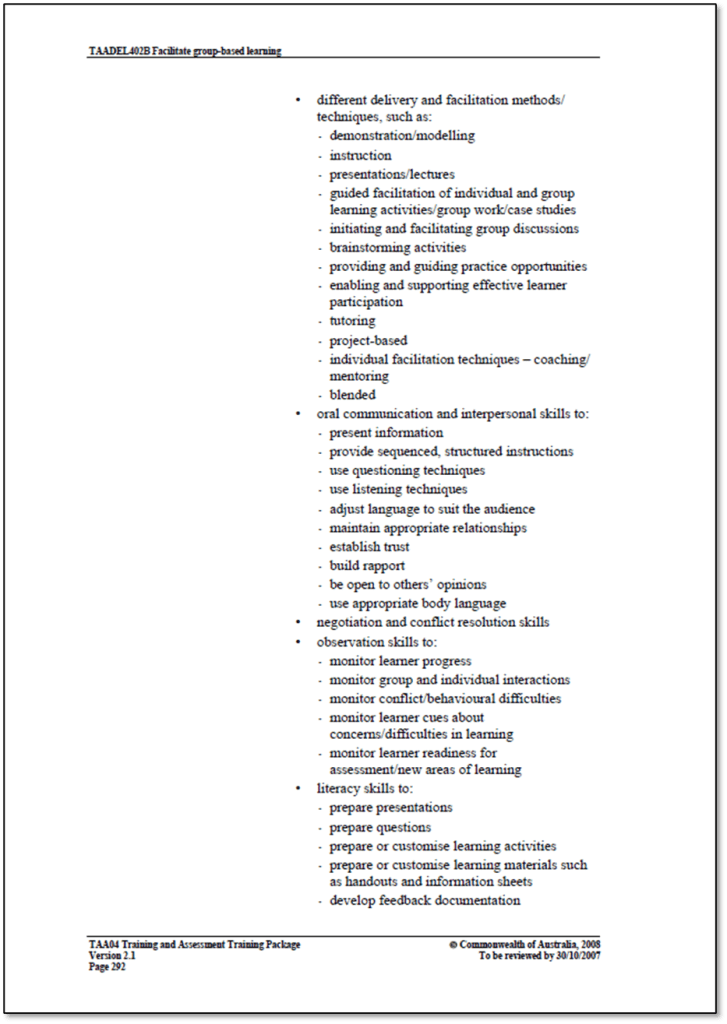
The following 3 pages is an example of how Employability Skills were explicitly embedded in the TAEDEL402B Facilitate group-based learning unit of competency (initially released in 2004).
In the above the 3 pages, the technical and non-technical skills were given under the heading, ‘Required skills and attribute’. The Employability Skills were embedded, and the information provided context and details.
2012
In 2012, a new Standards for Training Packages were released. This coincided with the release of the Australian Core Skills Framework (ACSF) and the Core Skills for Work Developmental Framework (CSfW).
Australian Core Skills Framework (ACSF)
The Australian Core Skills Framework (ACSF) is a tool which assists both specialist and non-specialist English language, literacy and numeracy (LLN) practitioners describe an individual’s performance in the five core skills of learning, reading, writing, oral communication, and numeracy. [3]
Core Skills for Work Developmental (CSfW)
The Core Skills for Work Developmental Framework describes a set of non-technical skills that underpin successful participation in work. These skills are often referred to as employment or generic skills. [4]
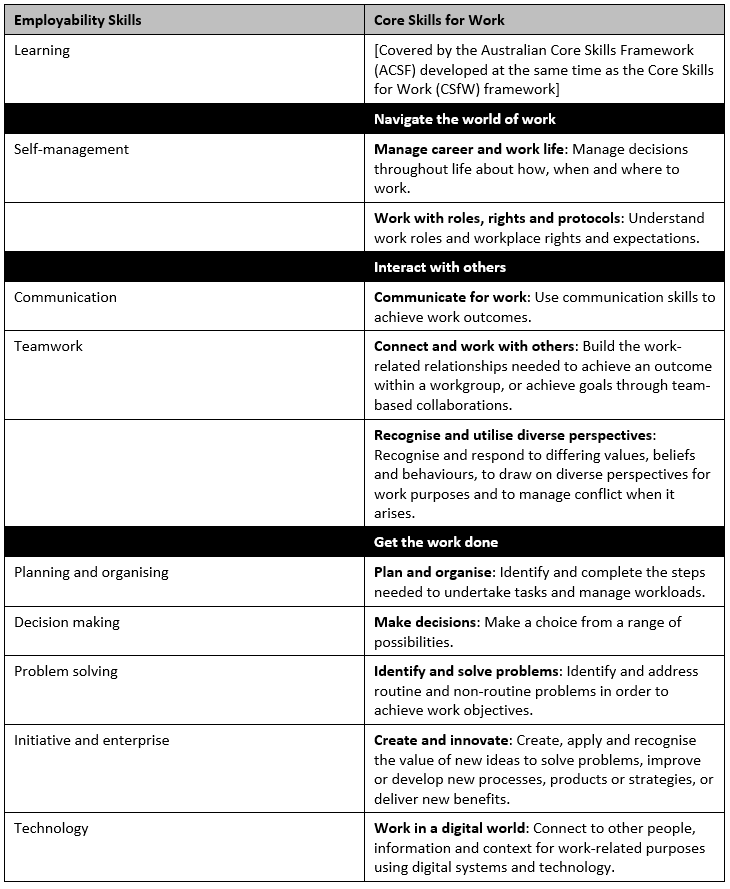
The Cores Skills for Work were developed to replace the Employability Skills. The following table compares the Employability Skills with the Cores Skills for Work.
Foundation skills
The 2012 Standards for Training Packages introduced ‘Foundation skills’. Foundation skills describes employment skills and LLN skills and that are essential to performance of the work task. [4]
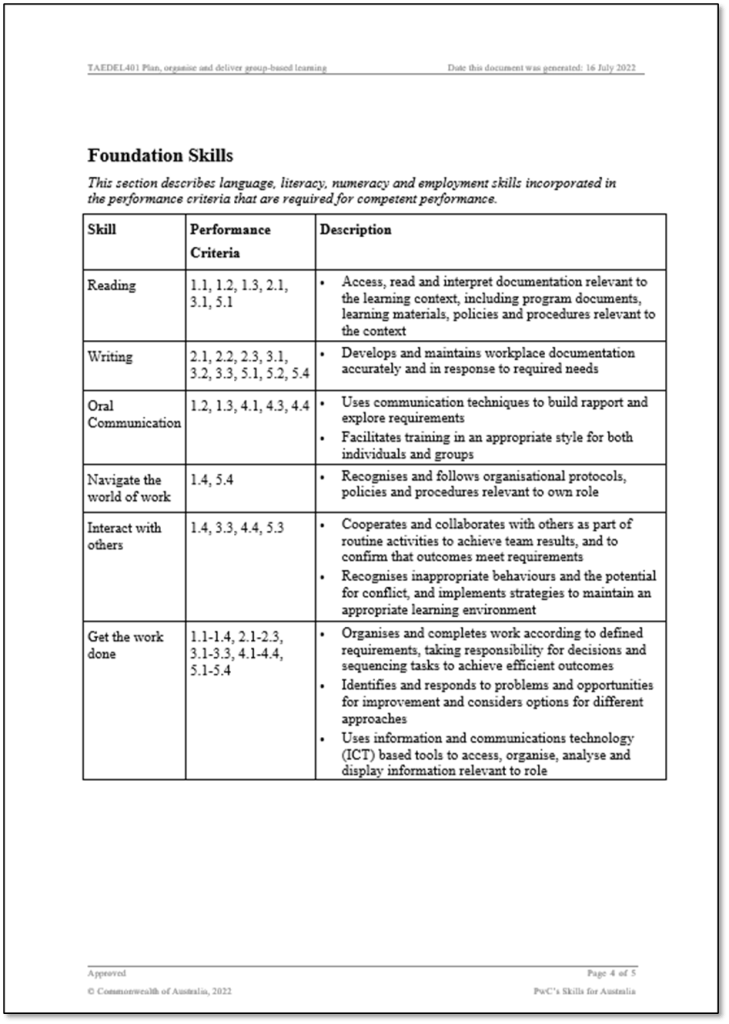
The following is an example of the foundation skills described for the TAEDEL401 Plan, organise and deliver group-based learning unit of competency.
In the above example, one reading skills, one writing skill, two oral communication skills, and six employment skills. The Core Skills for Work framework has been used to describe the employment skills. The foundation skills have been described within the context of performing the work task.
Also, this example provides useful mapping information that clearly links each foundation skill with the relevant performance criteria.
Note: Not every Training Package developer has described Foundation Skills in the same way. And some Training Package have limited or no details about Foundation Skills.
2022
It has taken 10 years for Training Packages to implement the ‘new format’ specified by the Standards for Training Packages that were released in 2012. However, there is still a small number of qualifications that are still in the ‘old format’, for example: [5]
14 qualifications in the MEM05 Metal and Engineering Training Package
9 qualifications in the LMT07 Textiles, Clothing and Footwear Training Package
And some qualifications in the CPC08/CPC Construction, Plumbing and Services Training Package may not need to transition to the ‘new format’ version of the qualification until 2024.
Some changes in the Australian VET system are slow. This can create issues because ‘new changes’ commence while ‘old changes’ are still being implemented. And this can lead to confusion and chaos, and people then scream out for more changes. The management of change in the Australian VET system has often been lacking. Also, we should recognise that not all changes lead to improvements.
On the 31th of August 2022, the TAFE Directors Australia (TDA) presented a webinar about ‘general capabilities’. The advertisement for this webinar stated:
General capabilities, often referred to as employability skills are increasingly important. In the process of attaining a tertiary education qualification learners will acquire and demonstrate general capabilities. These general capabilities are fundamental for success as a lifelong learner, and they are demanded by industry as necessary for successful workforce participation. Lifelong learning has become essential as workplaces demand existing workers to continually uplift their skills.
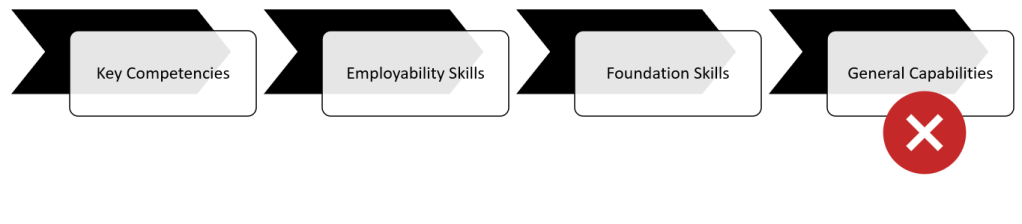
The The Mayer Key Competencies were mentioned at the start of the webinar. Then the webinar proceeded to blurred ‘general capabilities’ with ’employability skills’ and ‘foundation skills’.
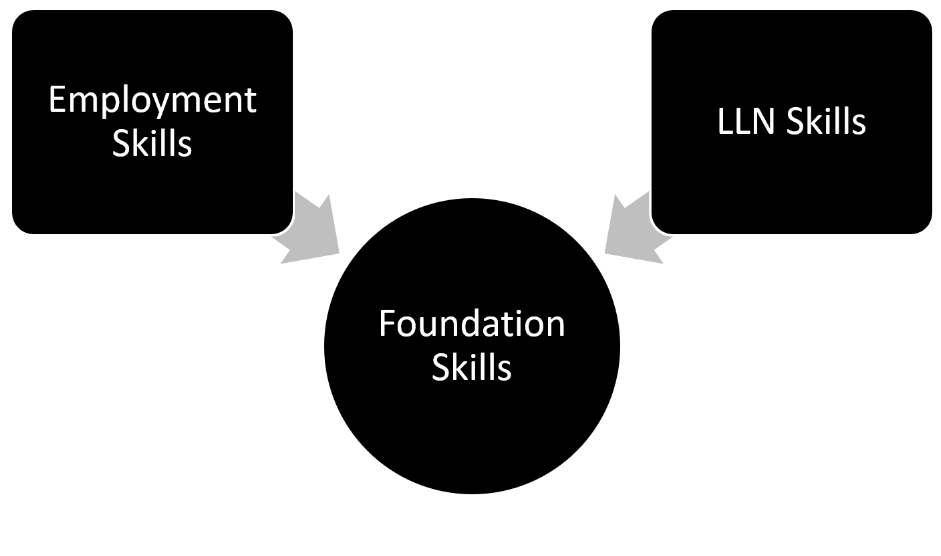
The following diagram illustrates the path that the VET system has taken over the pass 30 years. We don’t need yet another thing to replace the existing foundation skills.
I believe that we should embrace ‘Foundation Skills’ as they are, and integrate these skills when delivering training to develop the capability of performing work tasks.
Note: Not every Training Package developer has described Foundation Skills in the same way. And some Training Package have limited or no details about Foundation Skills.
Integration of foundation skills
Integration means identifying when foundation skills are used to perform the work tasks, and then delivering training to develop the required skills immediately prior to, or at the same time as, delivering training that addresses the performance. Here is a 3-step process when designing training that integrates the learning of work tasks and the development of skills to perform those work skills.
Step 1 Number each foundation skill
Foundation Skills are not numbered. The following example for the TAEDEL401 Plan, organise and deliver group-based learning unit of competency illustrates one approach that can be used to give each foundation skill a number.
Step 2 Identify link between performance criteria and required skills
The following matrix is an example for the TAEDEL401 Plan, organise and deliver group-based learning unit of competency. It can be used to visually identify the link between each performance criteria and the foundation skills.
The above matrix can be used to identify the links between performance criteria and foundation skills. For example:
It shows that reading , organising, and technology skills are required for the performance specified by Performance Criteria 1.1
It shows that reading skills are required for Performance Criteria 1.1, 1.2, 1.3, 2.1, 3.1, and 5.1
Step 3 Determine learning strategy and sequence
After identifying the linkage between performance criteria and foundation skills, we can determine the learning strategy and sequence of delivery.
Integration of knowledge
Integration means identifying when particular knowledge is used to perform the work tasks, and then delivering training to develop the required knowledge immediately prior to, or at the same time as, delivering training that addresses the performance. The Assessment Requirements for each unit of competency specify the required knowledge under the heading ‘Knowledge Evidence’.
Here is a 3-step process when designing training that integrates the learning of work tasks and the learning of knowledge to perform those work skills.
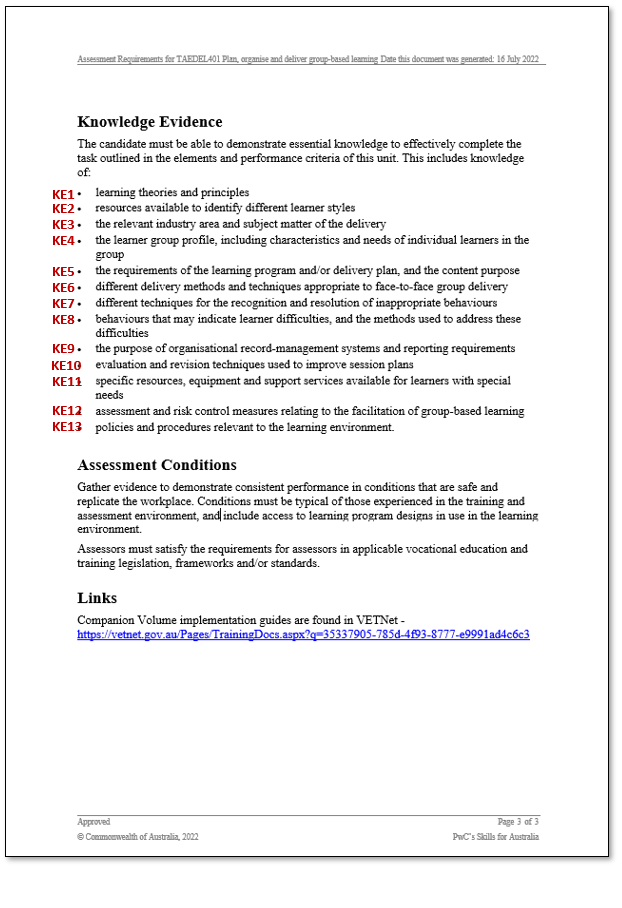
Step 1 Number each Knowledge Evidence item
Knowledge Evidence items are not numbered. The following example for the TAEDEL401 Plan, organise and deliver group-based learning unit of competency illustrates one approach that can be used to give each item of Knowledge Evidence a number.
Step 2 Identify link between performance criteria and required knowledge
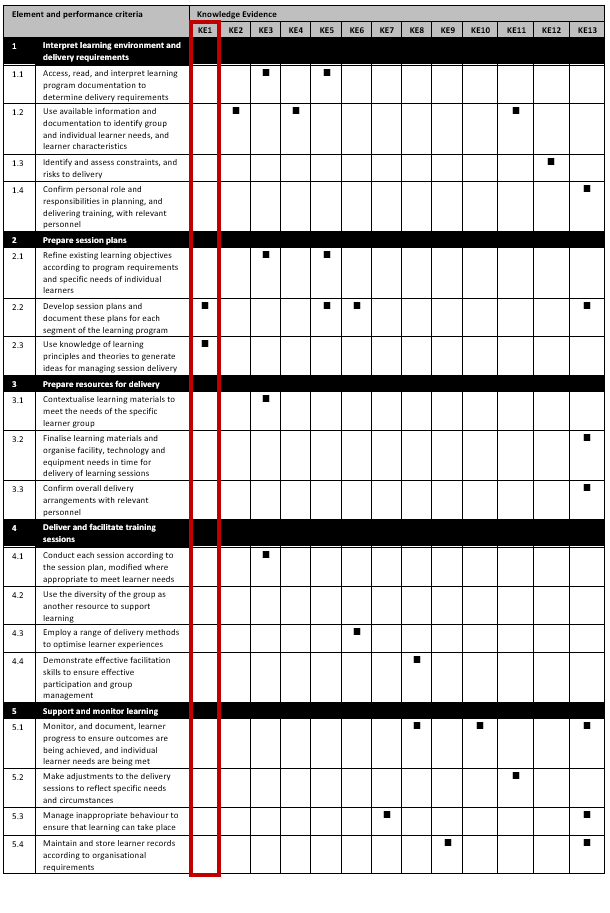
The following matrix is an example for the TAEDEL401 Plan, organise and deliver group-based learning unit of competency. It can be used to visually identify the link between each performance criteria and required knowledge.
The above matrix can be used to identify the links between performance criteria and required knowledge. For example, it shows that a knowledge of learning theories and principle (KE1) is required for Performance Criteria 2.2 and 2.3.
Step 3 Determine learning strategy and sequence
After identifying the linkage between performance criteria and required knowledge, we can determine the learning strategy and sequence of delivery.
Putting it all together
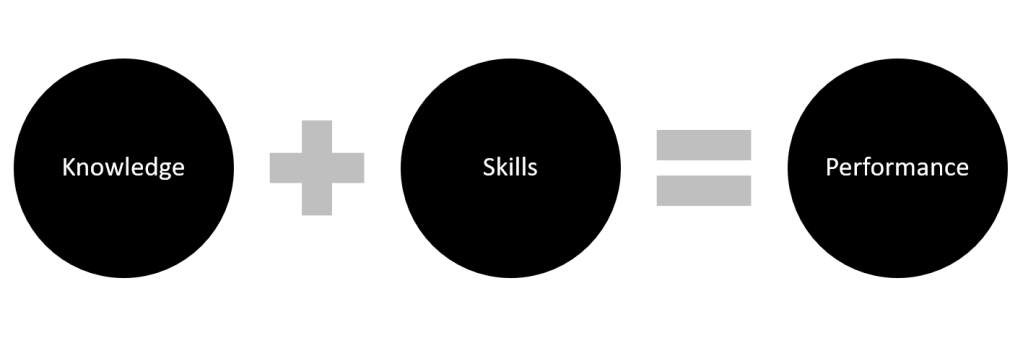
A person will need to learn the required knowledge and required skills to develop their capability to perform a work task.
The following matrix is an example for the TAEDEL401 Plan, organise and deliver group-based learning unit of competency. It makes the connection between the required knowledge (Knowledge Evidence), required skills (Foundation Skills), and the performance of the work task (Performance Criteria).
It does take time to unpack and re-assemble the Unit of Competency and Assessment Requirements. However, better and more coherent training can be delivered.
Note: The above matrix can also be used as a diagnostic tool. For example, if a person is have difficulties learning the particular work task, we can determine the likely lack of knowledge or skill that needs to be addressed.
In conclusion
A competent person at work will require knowledge, technical skills, and non-technical skills.
Elements and Performance Criteria specify the performance of a particular work task.
Knowledge Evidence specify the required knowledge.
Foundation Skills specify the required skills.
We need to unpack and re-assemble the information in a Unit of Competency and Assessment Requirements to deliver effective training that integrates knowledge, skills and performance.
References
[1] Standards for RTOs 2015, Glossary
[2] Foundation Skills Training Package Implementation Guide v1.1
Are you doing the TAE40122 Certificate IV in Training and Assessment, and are you struggling with your studies? Do you want help with your TAE studies?
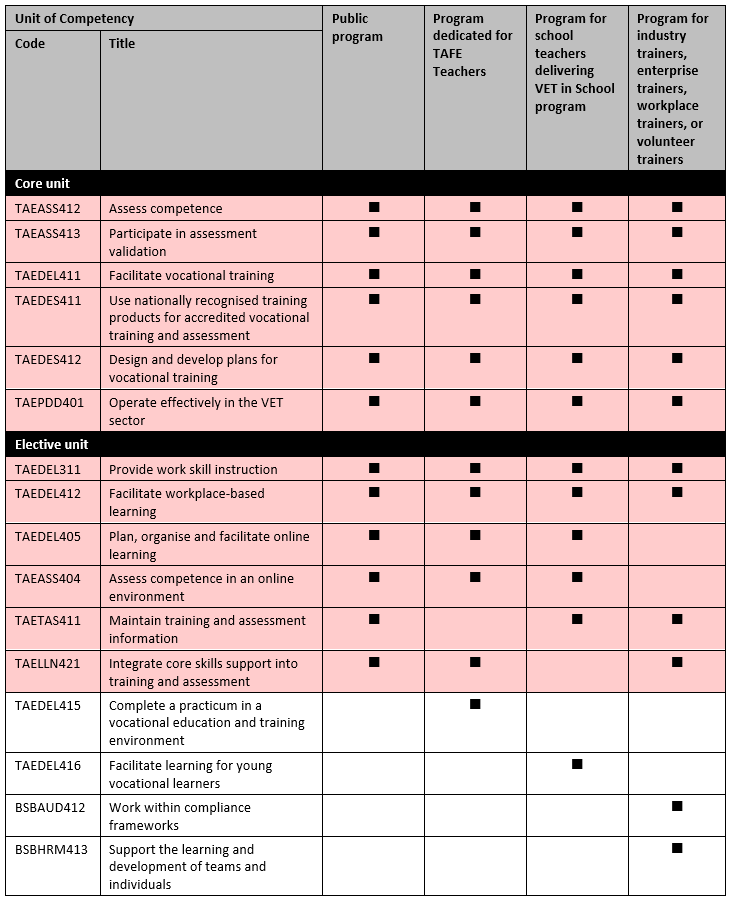
The packaging rules for the draft TAE40122 Certificate IV in Training and Assessment qualification were used to select elective units at the VET Practitioners Network (VPN) meeting held on Friday 5 August 2022. Four different cohorts were considered:
TAE40122 Public program / General program
TAE40122 Program dedicated for TAFE Teachers
TAE40122 Program for school teachers delivering VET in School program
TAE40122 Program for industry trainers, enterprise trainers, workplace trainers, or volunteer trainers who are delivering a VET program.
Packaging rules
The TAE40122 packaging rules require a total of 12 units of competency for the qualification consisting of 6 core units and 6 elective units.
TAE40122 Public program / General program
Learners enrolled in a TAE40122 Public program / General program are from various industry sectors and are destined to work for different types of RTO. It is normal to have many people in this cohort who will connected to apprenticeship, traineeship or work placements. Therefore, the TAEDEL412 Facilitate workplace-based learning unit of competency would be a desirable elective unit.
Also, it has become common for many RTOs to deliver online training. Therefore, the TAEDEL405 Plan, organise and facilitate online learning and TAEASS404 Assess competence in an online environment units of competency would be suitable electives units.
The following shows the units of competency for a TAE40122 Public program / General program:
Core units
TAEASS412 Assess competence
TAEASS413 Participate in assessment validation
TAEDEL411 Facilitate vocational training
TAEDES411 Use nationally recognised training products for accredited vocational training and assessment
TAEDES412 Design and develop plans for vocational training
TAEPDD401 Operate effectively in the VET sector
Elective units
TAEDEL311 Provide work skill instruction
TAEDEL412 Facilitate workplace-based learning
TAEDEL405 Plan, organise and facilitate online learning
TAEASS404 Assess competence in an online environment
TAETAS411 Maintain training and assessment information
Select one of the following:
TAELLN421 Integrate core skills support into training and assessment
TAEDEL416 Facilitate learning for young vocational learners
Note:
The TAELLN421 Integrate core skills support into training and assessment unit of competency is still a useful, and this would be better than selecting the TAEDEL416 Facilitate learning for young vocational learners unit of competency.
TAE40122 Program dedicated for TAFE Teachers
Some TAFE deliver will deliver a TAE40122 program for their own newly employed TAFE Teachers. The following shows the units of competency that could be used for a program dedicated for TAFE Teachers:
Core units
TAEASS412 Assess competence
TAEASS413 Participate in assessment validation
TAEDEL411 Facilitate vocational training
TAEDES411 Use nationally recognised training products for accredited vocational training and assessment
TAEDES412 Design and develop plans for vocational training
TAEPDD401 Operate effectively in the VET sector
Elective units
TAEDEL311 Provide work skill instruction
TAEDEL412 Facilitate workplace-based learning
TAEDEL405 Plan, organise and facilitate online learning
TAEASS404 Assess competence in an online environment
TAELLN421 Integrate core skills support into training and assessment
Select one of the following:
TAEDEL415 Complete a practicum in a vocational education and training environment
TAEDEL416 Facilitate learning for young vocational learners
TAETAS411 Maintain training and assessment information
TAE40122 Program for school teachers delivering VET in School programs
Some school teachers deliver VET in School programs.
Core units
TAEASS412 Assess competence
TAEASS413 Participate in assessment validation
TAEDEL411 Facilitate vocational training
TAEDES411 Use nationally recognised training products for accredited vocational training and assessment
TAEDES412 Design and develop plans for vocational training
TAEPDD401 Operate effectively in the VET sector
Elective units
TAEDEL311 Provide work skill instruction
TAEDEL412 Facilitate workplace-based learning
TAEDEL416 Facilitate learning for young vocational learners
TAELLN421 Integrate core skills support into training and assessment
Select two of the following:
TAEDEL405 Plan, organise and facilitate online learning
TAEASS404 Assess competence in an online environment
TAETAS411 Maintain training and assessment information
TAE40122 Program for industry trainers, enterprise trainers, workplace trainers, or volunteer trainers who are delivering a VET program
This cohort is diverse and their skill requirements may vary. For example, a TAE40122 program for nurses may be different than a TAE40122 program for police, or a TAE40122 program for workers at a mine site, or a TAE40122 program for trainers at a community centre.
The following shows the units of competency that could be used for a TAE40122 program for industry, enterprise, workplace or volunteer trainers:
Core units
TAEASS412 Assess competence
TAEASS413 Participate in assessment validation
TAEDEL411 Facilitate vocational training
TAEDES411 Use nationally recognised training products for accredited vocational training and assessment
TAEDES412 Design and develop plans for vocational training
TAEPDD401 Operate effectively in the VET sector
Elective units
TAEDEL311 Provide work skill instruction
TAEDEL412 Facilitate workplace-based learning
TAETAS411 Maintain training and assessment information
BSBAUD412 Work within compliance frameworks
BSBHRM413 Support the learning and development of teams and individuals
Select one of the following:
TAELLN421 Integrate core skills support into training and assessment
TAEDEL405 Plan, organise and facilitate online learning
TAEASS404 Assess competence in an online environment
Notes:
The two BSB units have been selected to to fill up the course, not because they would add value. The aim is to avoid delivering irrelevant units of competency.
The TAEDEL414 Mentor in the workplace unit of competency may be relevant for a TAE40122 program for nurses and midwives.
Summary of packaging rule
The packaging rules for the TAE40122 qualification provide an unnecessary level of flexibility. The following is a chart that compares the selection of units of competency for four different cohorts. The pink identified that twelve units of competency that are most likely to be used by RTOs delivering the TAE40122 qualification.
In conclusion
This article should be seen as a valuable contribution to the implementation of the TAE40122 Certificate IV in Training and Assessment qualification. It provides new insight into how the TAE40122 packaging rules can be used.
Increased total number of units
The TAE40122 qualification will require 12 units of competency compared with 10 units of competency for the TAE40116 qualification. The increased number of units is probably unnecessary. Units of competency are likely to be selected to pad out the program rather than address any particular skills required to perform the role of a trainer and assessor working in VET.
Greater flexibility
The packaging rules for the TAE40122 qualification have been designed to provide greater flexibility (6 core units, 6 elective units) compared with the TAE40116 qualification (9 core units, one elective unit). It is highly unlikely that this greater flexibility will be used. It probably indicates that this greater flexibility was unnecessary.
Fit for purpose
The TAE40116 qualification was condemned because some people said it was not fit for purpose. Will the TAE40122 qualification be seen as fit for purpose? Or, will the complaints about the Certificate IV in Training and Assessment continue after the TAE40122 qualification has been implemented? What do you think?
Do you need help with your TAE studies?
Are you doing the TAE40122 Certificate IV in Training and Assessment, and are you struggling with your studies? Do you want help with your TAE studies?
Submissions to the public validation for the draft TAE Training Package closed on Friday 12th of August 2022. The new TAE Training Package is expected to be endorsed and released for use before the year ends.
There were many complaints raised about the draft TAE Training Package during the public validation period. I predict that complaints about the Certificate IV in Training and Assessment qualification will continue after it has been endorsed.
Some people will still say that the Certificate IV in Training and Assessment qualification is not fit for purpose. Some people will still identify issues or disagree with the details covered by TAE Units of Competency.
I do not believe that the TAE40122 Graduate will be any better than a TAE40116 Graduate. And in some respects, the TAE40122 Graduate may have training and assessment skills that are less than those of a TAE40116 Graduate.
It’s all over but the shouting
The following lyrics to a song, ‘It’s all over but the shouting’, were written by JD Pherson in 2015.
It’s all over but the shouting It’s all done but the deed It’s all healed but the hurtin’ It’s all taken but the heed It’s all over but the shouting It’s all gone but the need.
These words capture my thoughts and feelings about the proposed TAE40122 Certificate IV in Training and Assessment qualification. I have reflected upon these words. I have thought about the changes to the Certificate IV in Training and Assessment qualification and the TAE Units of Competency. And I have thought about the process that has been used to determine these changes.
Will you shout for joy when the TAE40122 qualification is released? Will you shout with frustration or despair?
What are your thoughts and feelings about the new TAE40122 qualification?






















 On Target Work Skills