What are the key features of the Australian VET system?

This image of Vegemite, cake, sausage, pizza, sandwich and training wheels on a bike will only make sense half way through this article.

I have discovered that ChatGPT can be addictive. This morning I asked ChatGPT, what are the key features of the Australian VET system?

Here is the first response given.

Not a bad answer. However, I would edit the terms ‘Accredited training providers’ to be ‘Registered training providers’, and ‘private colleges’ to be ‘private training providers’.

Again using ChatGPT, I regenerated the response to the same question and was given the following.

Again, not a bad answer. But I dislike the American English spelling of words with a ‘z’ rather than the Australian English spelling of words with an ‘s’. For example, ‘recognize’ should be ‘recognise’.

And I may disagree that there is consistency across all states and territories. There is often great inconsistencies from one RTO to another RTO. Therefore, this may be misleading. Also, it may be contestable to say that the Australian VET system is highly regarded. This claim would need further evidence or justification.

Next, I got ChatGPT to regenerate the answer to the same question but to make it funny. And this is what I was given.
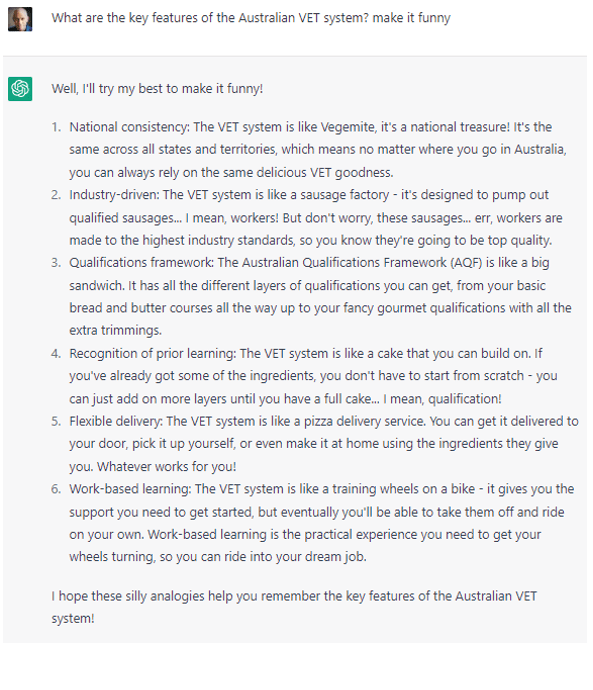
Well done ChatGPT! However, some Victorians may remember that in recent years a TAFE was involved in the rorting of government funding, and one of the rorters referred to what they were doing as a ‘sausage factory’. So, this may not be funny to some people, but the full analogy is nicely written.

I regenerated the response and was given the following.
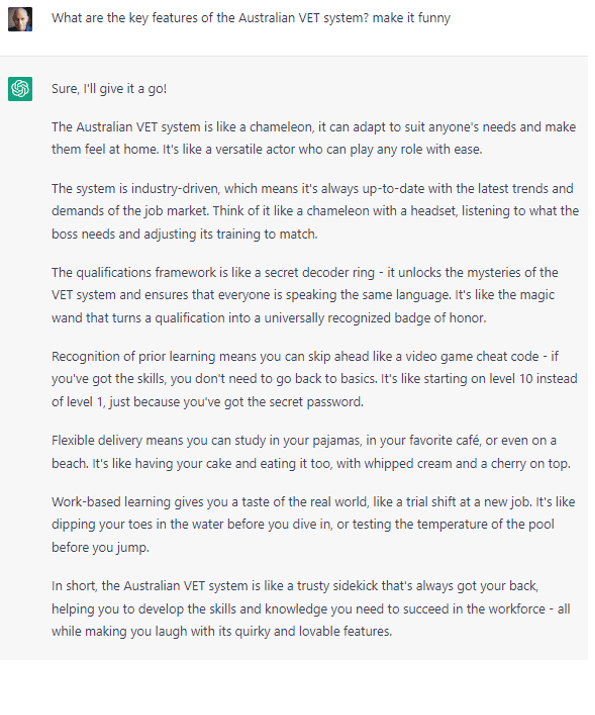
I don’t think the second response is as good as the first response, but there are some interesting ideas.

I wonder if ChatGPT can be used as a discussion generator when delivering the Certificate IV in Training and Assessment or Diploma of Vocational Education and Training. It could be a bit of fun. What do you think?

Postscript

I added this postscript about 6 hours after publishing the article because I had received some comments that prompted me to further use ChatGPT.

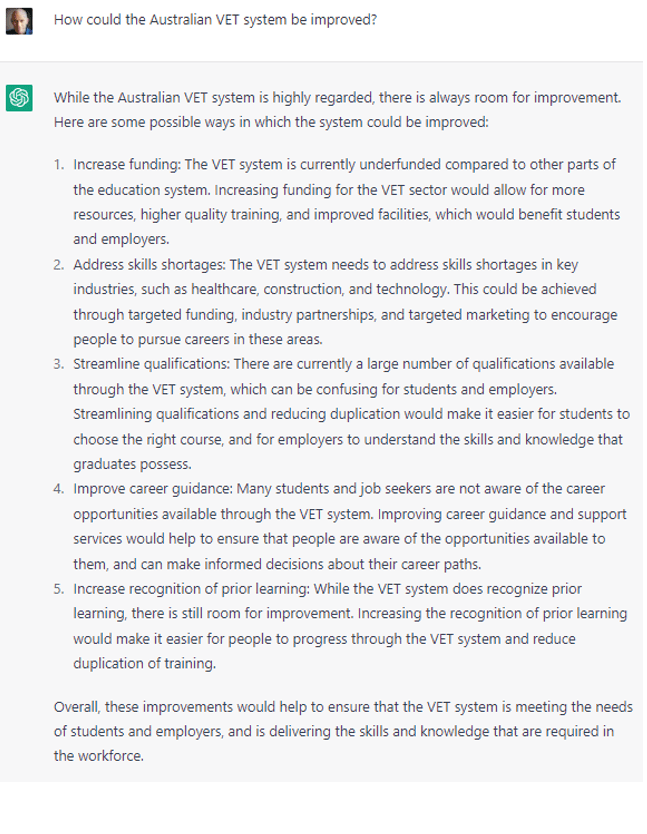
How could the Australia VET system be improved?
A vision statement for the Australian VET system

This vision statement is quite inspirational. I think it is better written than the current vision statement that was agreed by Skills Ministers and endorsed by the National Cabinet on 31 August 2022 (replacing the previous government’s vision statement that was released three years earlier). Did you know that there was a vision statement for the Australian VET system? Here it is.

Reference: https://www.dewr.gov.au/skills-reform/national-skills-agreement-vision-and-principles accessed 21 February 2023

And finally, I use ChatGPT to compare the Australian VET system with honey.
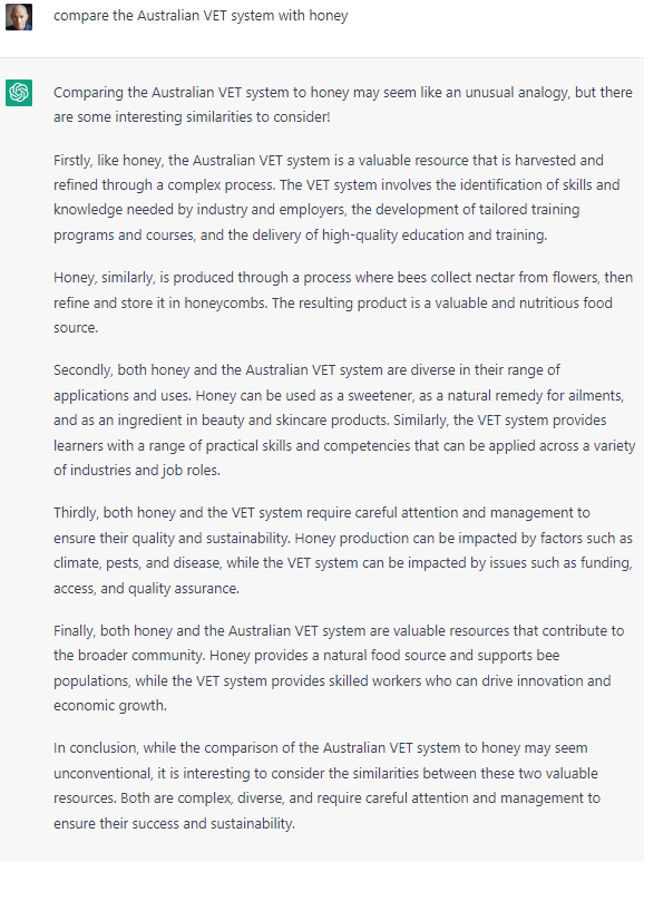
I had better stop now before it gets too silly. I had thought of asking ChatGPT to provide an answer in the writing style of Dr Seuss.

Oops! Too late …

Do you need help with your TAE studies?

Are you a doing the TAE40122 Certificate IV in Training and Assessment, and are you struggling with your studies? Do you want help with your TAE studies?

Ring Alan Maguire on 0493 065 396 to discuss.

Contact now!

logo otws

Training trainers since 1986

Selection and sequence of units for the TAE40122 qualification

Structure for the TAE40122 qualification

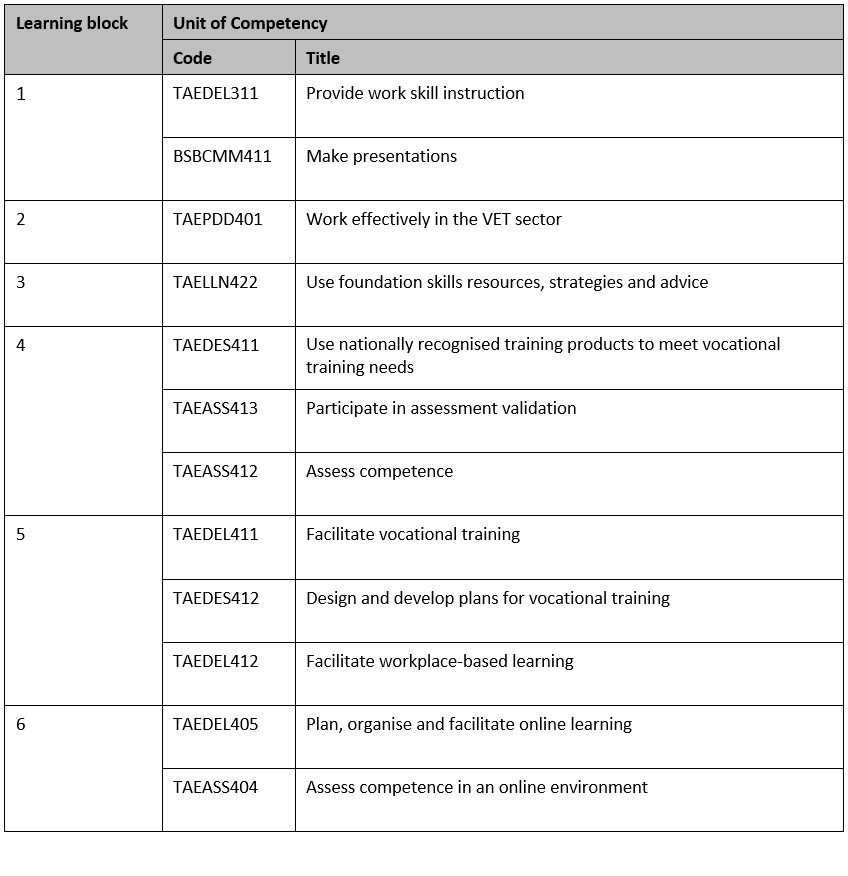
I have recently looked at a proposed selection and sequence of units for the new TAE40122 Certificate IV in Training and Assessment qualification. The following has been suggested as the units, order of units, and clustering of units.

I didn’t like the above for many reasons. For me, it is incoherent and would result in significant duplication of assessment tasks. TAE student and TAE assessors would be burgeoned by additional and unnecessary workload.

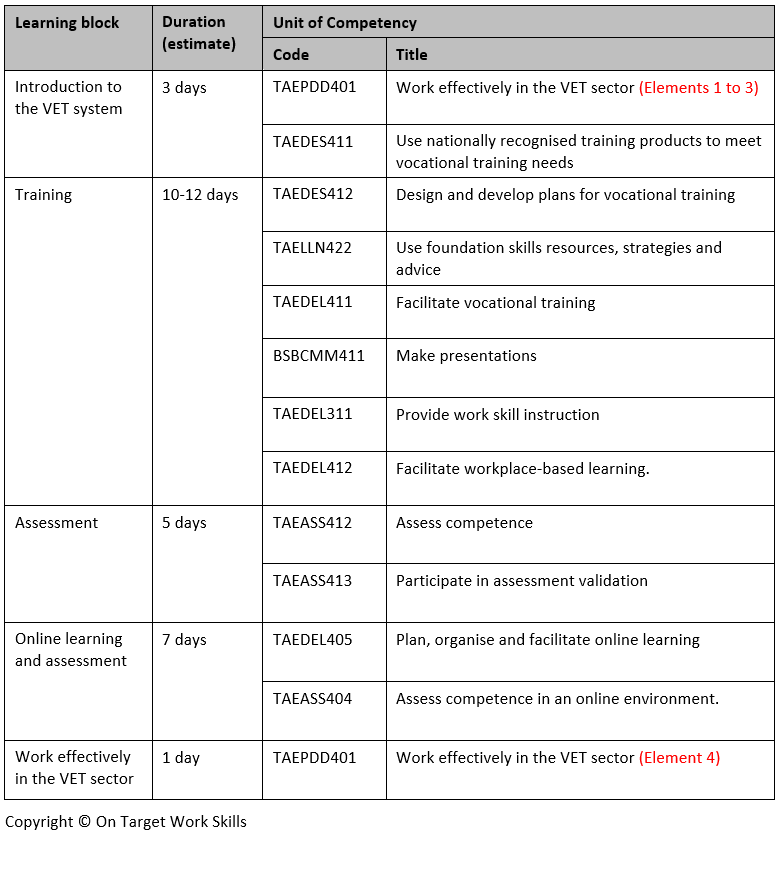
The following is my suggested sequence and clustering of the same units. It consists of five learning block. Also, it includes my estimated duration for trainer-led delivery of the TAE40122 qualification.

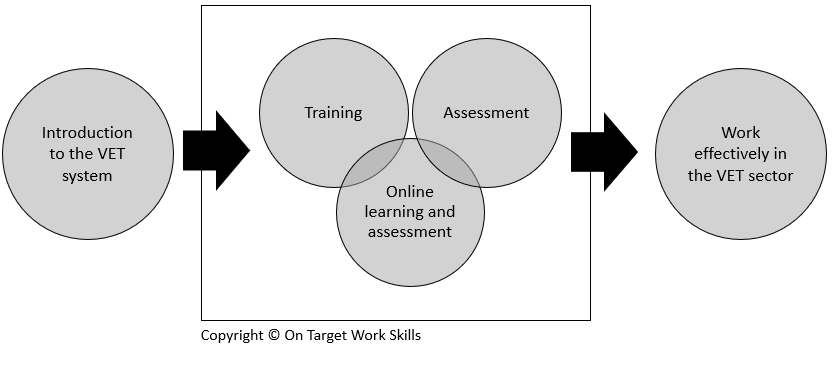
The following diagram illustrates the logic or the rationale for my sequence and clustering. It makes sense to start with the big picture being an introduction to the Australian VET system. Followed by how to design and deliver training, how to conduct and validate assessment, and how to deliver training and conduct assessment in an online environment. The TAE40122 training program concludes by covering how to work effectively in the VET sector, including the ongoing professional development after the the training program has concluded.

My proposed structure and sequence gives a sensible and logical flow to the Certificate IV in Training and Assessment qualification. It brings focus to the topics of training and assessment.

Integrated assessment

The new TAE units of competency are complex and consist of a duplication of content. The above suggested structure for the TAE40122 qualification aims to simplify and combine assessment requirements.

Here is an example about how I have created an integrated assessment approach for the Training learning block.

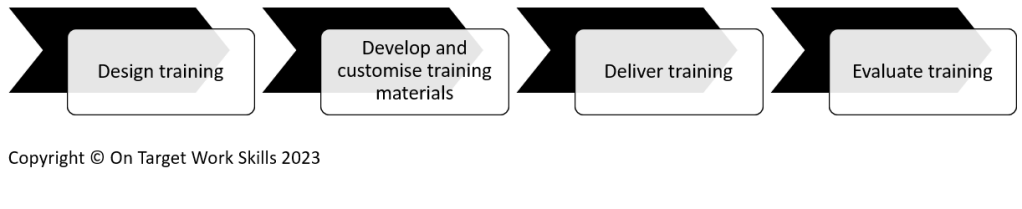
First, I have taken a typical systematic approach to training.

Next, I identified two broad functions performed by a trainer that are specified by the various TAE units of competency:

  • Small group training
  • Work-based learning.

Note: A small group is defined as being a group of at least four learners, and the scope of work-based learning is the training of an individual.

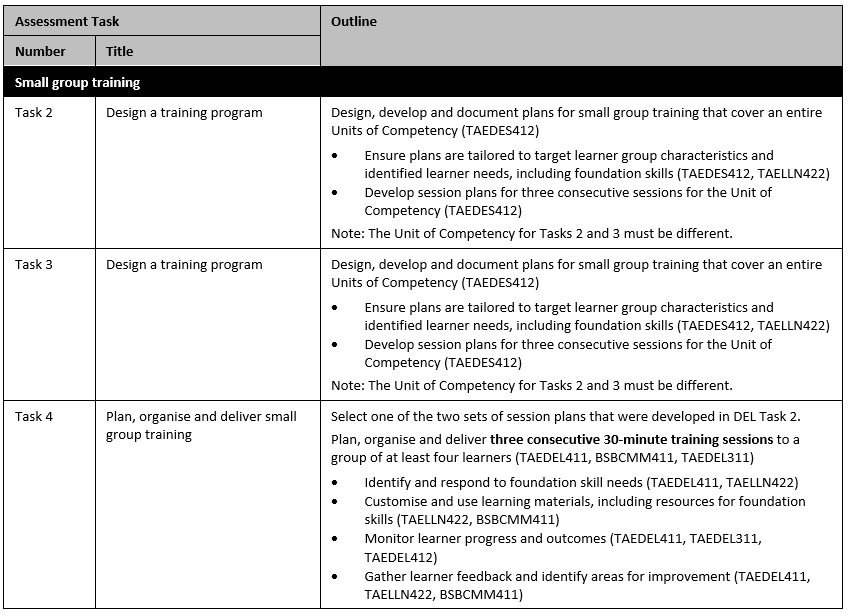
The following jumps a few steps to show you some details of my assessment tasks for the six units of competency that have been clustered together for the Training learning block.

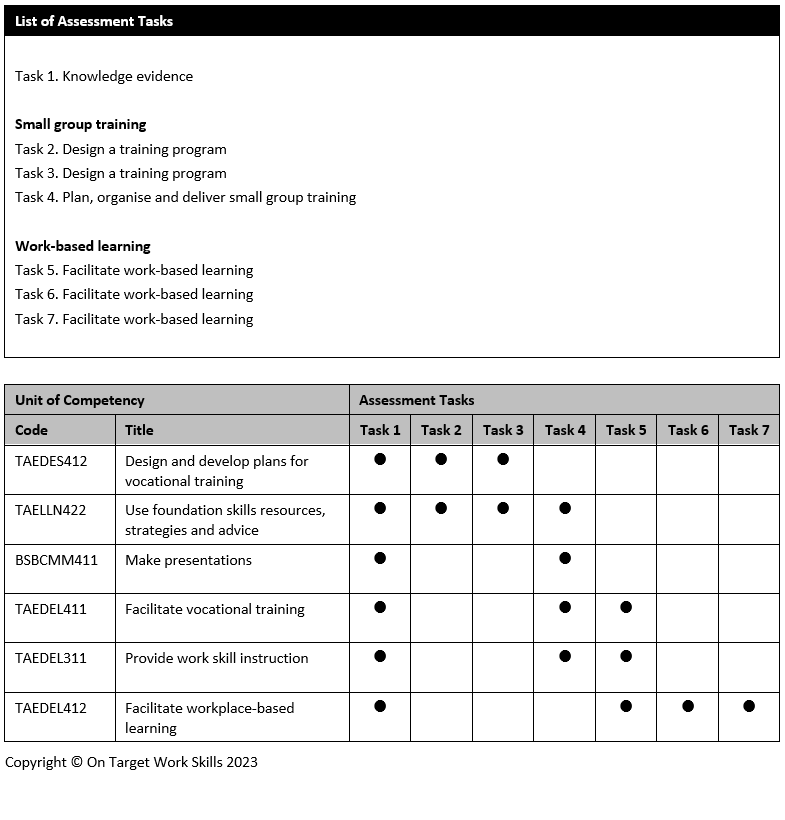
The following takes away some of the above details and give an outline of my integrated assessment approach.

In conclusion

Generally, the new TAE units of competency have been poorly designed. They are complex and can be confusing. Some common content is duplicated across various TAE units of competency. But, this should not mean that the delivery of the TAE40122 qualification should be complicated and confusing.

This article illustrates how to design a TAE40122 training program so that it simple, logical, and avoids duplication of content. An integrated assessment approach can minimise the workload of TAE students and TAE assessors.

If you work for an RTO with the TAE40122 qualification on its scope of registration, and if you are trying to figure out how to implement it, please give me a call on 0493 065 396 to discuss how I could help you.

Do you need help with your TAE studies?

Are you a doing the TAE40122 Certificate IV in Training and Assessment, and are you struggling with your studies? Do you want help with your TAE studies?

Ring Alan Maguire on 0493 065 396 to discuss.

Contact now!

logo otws

Training trainers since 1986

What’s one thing that is wrong with the Australian VET system?

You may ask, “is there only one thing wrong with the Australian VET system?” And you are probably right to say that there is more than one thing that is wrong with it. But I have come to the conclusion that Prime Ministers and government ministers with the responsibility for the Australian VET system do not have, or have limited, understanding of the VET system. And this is, and has been, a major cause of the deterioration in the effectiveness and quality of Australia’s VET system.

The rise and fall of the Australian VET system

The current VET system was introduced in 1993. It was 30 years ago that we established a national VET system that recognised the importance of industry engagement, and industry leadership. Also, the VET system changed from curriculum-based to competency-based. In the background, or foreground, has always been the desire to deliver relevant and quality training. Australia was proud to have a VET system that was world-class, if not world-leading.

The following is my representation of the incline and decline of the Australian VET system. Many people who been around the VET system for awhile would have experienced a continued improvement of the VET system between 1993 and 2008. And they have probably thought that the VET system has deteriorated over the past decade, or so.

Kevin Rudd won the federals election in 2007 (Kevin 07). Then we had the Global Financial Crisis(GFC) that required Australia to make significant economic decisions. These decisions included substantive reforms to the Australian VET system. This was a turning point for VET in Australia because it started a continuous, and relentless series of changes. Since 2008, many changes have been introduced prior to previous changes being fully implemented. The VET system has become unstable, and teeters on the edge of chaos. In the name of ‘simplification’, the Australian VET system becomes more complex. The current reforms again promises ‘simplification’ but will deliver greater complexity.

Current reforms to the Australian VET system

Everything in the Australian VET system is being changed.

I think that the biggest problem with Australia’s VET system is that we do not have one creator or one architect. We have consultations, sometimes sham consultations, to determine what changes are needed. Ignorant, misinformed, and conflicted people are given the opportunity to contribute their ideas. Good and bad ideas are embraced by government. Some of the bad ideas are theoretical, unproven or based on ideology. Sometimes research is conducted so that the government can say that they are making decision based on evidence. But some research is limited or biased. Very few people have the time, intellect, or interest in combating government decisions or proposed changes.

The architect of the current reforms, or changes, to the VET system was Steven Joyce, an ex-politician from New Zealand. He did an extremely short-duration review of the entire Australian VET system. The ‘Joyce Review’ provided Scott Morrison with a blueprint for his government to take to the 2019 federal election. The Scott Morrison government won the federal elections in May 2018, and commenced implementing the recommendations from the ‘Joyce Review’.

VET system and political interference

The VET system is influenced by political interference. It is subjected to interference by politicians. Australian Government invest billions of dollars each year into the VET system, and as taxpayers we hope that our politician make good decisions and spend our money wisely. Sometimes, it seems that politicians spend money to appease their backers or to buy votes, rather than make positive changes that would make the VET system more efficient and effective.

The Prime Minister and the ministers responsible for VET, past and present, reply on their advisers and their bureaucrats for ideas. And these ideas are influent by VET experts and academics, lobby groups and associations. We end up with an incoherent patch-work of ill-conceived ideas. This is what the ‘Joyce Review’ provided and this is what has been implemented for the past four years. The impact of these changes will begin to be felt during 2023 and into 2024.

The future of Australia’s VET system

The current Anthony Albanese government did not stop, or pause, the reforms started by the previous government. It seems that the Prime Minister and Brendon O’Connor, the federal minister with responsibility for VET, agree with the massive changes started by their predecessors from the other side of politics. These changes may significantly damage, if not destroy, the Australian VET system. If destroyed, the VET system would need to be re-created again in about 5 years (two election cycles). This will cost billions and billions of tax-payer dollars.

I predict that people will continue to complain about poor quality training after the current changes have been fully implemented, and ‘skills shortages’ will prevail.

My conclusion

I come to the conclusion that our politicians is one thing that is wrong with the Australian VET system. They seem to think short term. They seem to lack understanding of the VET system and its history. They seem to lack systemic thinking. They seem to rely on advice or ideas from ignorant, naïve, self-interested or conflicted advisers, bureaucrats, lobbyists, VET experts and academics. I am not saying that our politicians are bad people. I am saying that the decisions they make can be bad.

It is a shame that the current changes to the VET system were not stopped when the Anthony Albanese government was elected. But they probably didn’t have a VET policy apart from ‘Free TAFE’. The current government probably didn’t, or doesn’t, understand the current changes to the VET system, or they agree with the changes.

It is probably too late. The implementation of changes to the Australia’s VET system were started by the previous government and the current government will complete the implementation before the next federal election. Both sides of politics can take the blame if the system is ruined.

Please tell me what you think.

TAEPDD401 Work effectively in the VET sector

The TAE40122 Certificate IV in Training and Assessment qualification was released on the 8th of December 2022. There are six core units of competency:

About this article

This article focuses on the TAEPDD401 Work effectively in the VET sector unit of competency. I am primarily writing this article for TAE Students who are studying for their TAE40122 Certificate in Training and Assessment qualification.

Elements of competency

The TAEPDD401 Work effectively in the VET sector unit of competency unit has four elements:

  • Interpret VET policy context
  • Operate within VET delivery and compliance framework
  • Work effectively with vocational learners
  • Plan to improve own professional practice.

Element 1. Interpret VET policy context

The title of this element of competency is an example of how difficult it can be to understand the terminology used in VET. What is meant by ‘policy context’? How do you demonstrate that have ‘interpreted’ it?

Basically, you will need to where to find the following information. And you will need to have a basic understand about what the information is and how the information relates to you.

  • Standards for RTOs
  • Users’ guide to the Standards for RTOs
  • Australian Qualifications Framework (AQF)
  • VET policy published by the Australian Government and State/Territory Governments.

As an entry-level trainer and assessor working for an RTO, you should only need to know the basics. You shouldn’t need to know the technical complexity of compliance.

Element 2. Operate within VET delivery and compliance framework

When working for an RTO, you will be asked to comply with the RTO’s policies and procedures that will have been developed to ensure compliance with legislation and regulations. Theses policies and procedures will usually include:

  • Workplace health and safety
  • Diversity and inclusion
  • Anti-discrimination
  • Privacy and confidentiality
  • Copyright and plagiarism
  • Service delivery
  • Support services
  • Records management
  • Complaints and appeals
  • Continuous improvement.

This element of competency requires you to understand your role as a trainer and assessor. A position description or job description will usually outline the functions, activities and tasks that you would be expected to perform when working for an RTO. These functions, activities and tasks will usually include:

  • Ensure safety of learners and others
  • Deliver training
  • Conduct assessments
  • Maintain training and assessment records
  • Contribute to continuous improvement
  • Engage in professional development activities.

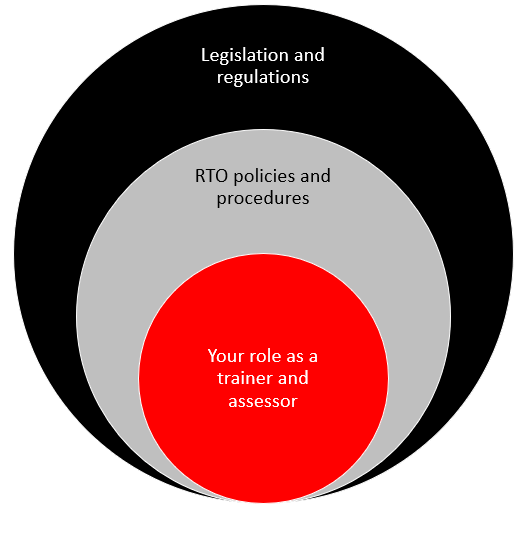
The following diagram shows the relationship between your role, an RTO’s policies and procedures, and legislation and regulations.

Element 3. Work effectively with vocational learners

This element of competency focuses on the learner, including:

Needs and expectations of learners

This element of competency focuses on the learner. Different learners can have different needs and expectations. The following are some different types of learners:

  • Learners who have recently completed secondary school with no or limited work experience
  • Adult learners with some or extensive work experience
  • Learners with a disability
  • Learners with low-level language, literacy or numeracy skills
  • Learners with English as their second language
  • Secondary school students doing a VET in Schools program or a School-Based Apprenticeship
  • Learners at a correctional centre.

Can you think how the needs and expectations could be different for each of the above learners? How might their needs and expectation impact on how, when, and where the training get delivered? What will motivate and keep the learner engaged? What support services may be required?

Individual learner needs

As a trainer and assessor, you may be required to identify and address individual learner needs. An RTO will attempt to identify the needs of learners at the time of enrolment. However, it is common for issues to arise during the delivery of training.

You are likely to have learners experiencing difficulties with learning, and you will need to address the needs of those individual learners. This may include activating support services. These situations will often need to be handled with sensitivity and compliance with an RTO’s policies and procedures, including anti-discrimination, privacy and confidentiality.

Learner feedback

As a trainer and assessor, you are likely to be encouraged to seek and act on feedback from learners. Feedback can be informal, such as a comment or conversation. And feedback can be formal, such as using a feedback form or evaluation form to gather feedback from learners. Also, complaints can be considered as a valuable source of feedback.

An RTO is likely to have policies and procedures that describe the processes for gathering and acting on feedback from learners. Feedback from learners can be used to improve the quality of the training and assessment service that we provide.

Element 4. Plan and improve own professional practice

If you work for an RTO, you will be required to participate in the planning of your own ongoing professional development. This is a requirement specified by the Standards for RTOs. The following diagram shows four areas of development that you may need to include in your professional development plan.

Assessment requirements for the TAEPDD401 unit

Knowledge evidence

An assessment task will be required to gather the specified Knowledge Evidence. A TAE Student must demonstrate they have the following knowledge:

  • Purpose of the VET Quality Framework and key content relevant to VET teachers, trainers and assessors
  • VET sector structure and roles and responsibilities of key stakeholders
  • Legislative and VET regulatory requirements relevant to VET teachers, trainers and assessors
  • Organisational requirements and procedures relating to working as a VET teacher, trainer and assessor at an RTO
  • Key components of plan to improve own professional practice
  • Features of the competency-based VET system
  • Diversity of learners in VET, their needs and expectations, and implications for own inclusive work practices
  • Current authorised Australian foundation skill frameworks used to analyse the foundation skill demands of training products and levels of learners and candidates
  • VET sector terminology, including terminology used in nationally recognised training products.

Performance evidence

The performance evidence will require the TAE Student to develop a plan for own future development as a VET trainer and assessor.

The TAEPDD401 Work effectively in the VET sector unit of competency would be best completed at the end of the TAE40122 Certificate IV in Training and Assessment training program.

Assessment conditions

An RTO that plans to deliver the TAEPDD401 Work effectively in the VET sector unit of competency should provide the TAE Student with the following:

  • RTO policies and procedure relating to continuous professional development
  • Job or role description for a VET trainer and assessor.

In addition, it would be useful for the TAE Student to be given:

  • A self-assessment checklist to identify potential areas for future development as a VET trainer and assessor
  • A template for documenting a professional development plan.

Do you need help with your TAE studies?

Are you a doing the TAE40122 Certificate IV in Training and Assessment, and are you struggling with your studies? Do you want help with your TAE studies?

Ring Alan Maguire on 0493 065 396 to discuss.

Contact now!

logo otws

Training trainers since 1986

TAEDES412 Design and develop plans for vocational training

The TAE40122 Certificate IV in Training and Assessment qualification was released on the 8th of December 2022. There are six core units of competency:

The above list is in alphabetical order for the unit codes.

About this article

This article focuses on the TAEDES412 Design and develop plans for vocational training unit of competency.

This unit has three elements:

  • Plan vocational training
  • Design plan for vocational training
  • Develop session plans for vocational training.

Assessment requirements for the TAEDES412 unit

Knowledge evidence

A TAE Student must demonstrate they have the following knowledge:

  • Legislative and VET regulatory requirements relating to designing and developing plans for training
  • RTO policies and procedures for designing, developing and finalising plans for training
  • Purpose and use of the National Register of VET, including identifying changes to nationally recognised training products
  • Basic instructional design principles relating to designing and developing plans for training
  • Purpose and key content of plans for training
  • Key components of training and assessment strategies
  • Facilitation techniques that support and engage learners and check for learner understanding
  • Features of different modes of delivery, and how those features are represented in plans for vocational training
  • Relationship between training and assessment and implications for designing and developing training plans
  • Types of learner characteristics, and implications for designing and developing plans for training
  • Processes for interpreting nationally recognised inits of competency to identify the standard of performance required
  • Contents of Companion Volume Implementation Guides relating to designing and developing plans for training
  • Sustainability matters to consider when designing and developing plans for training.

Do you need help with your TAE studies?

Are you a doing the TAE40122 Certificate IV in Training and Assessment, and are you struggling with your studies? Do you want help with your TAE studies?

Ring Alan Maguire on 0493 065 396 to discuss.

Contact now!

logo otws

Training trainers since 1986