TAESS00023 Online Learning and Assessment

Introducing the TAESS00023 Skill Set

The TAESS00023 Online Learning and Assessment Skill Set was released on the 1st of June 2022. The skill set consists of two units of competency:

  • TAEDEL405 Plan, organise and facilitate online learning
  • TAEASS404 Assess competence in an online environment.

This skill set addresses the skills and knowledge required to plan, organise and facilitate online learning and assess competence across various electronic applications and communication channels. It involves gathering evidence using both synchronous and asynchronous assessment methods, and making judgements on the outcomes of the online assessment using a range of devices and digital tools. [1]

Professional development

The new online learning and assessment units or skill set can deliver an immediate value for many TAFE teachers, trainers and assessors.

The TAESS00023 Online Learning and Assessment Skill Set can be used to deliver a structured professional development program for current trainers, assessors and TAFE teachers working in the VET sector.

In additional to being relevant professional development, the attainment of the two new online learning and assessment units can be used as credits towards the TAE40122 Certificate IV in Training and Assessment qualification (expected to be endorsed before the end of 2022). [2]

References

[1] https://training.gov.au/Training/Details/TAESS00023 accessed 1 June 2022

[2] https://www.skillsforaustralia.com/project-page/education-tae/ accessed 1 June 2022

Are you a doing the TAE40122 Certificate IV in Training and Assessment, and are you struggling with your studies? Do you want help with your TAE studies?

Do you want more information? Ring Alan Maguire on 0493 065 396 to discuss.

Contact now!

logo otws

Training trainers since 1986

Webinar: How to design competency-based assessment

Most TAFE teachers, trainers and assessors working for an RTO learnt about designing competency-based assessment when they studied for their Certificate IV in Training and Assessment qualification . But designing a competency-based assessment for real is often very different to learning about it at a TAE training course.

On Target Work Skills is delivering a training webinar that provides a simple and practical approach to designing competency-based assessment. The aim is to improve capability for new and experienced VET practitioners.

Webinar objectives

The webinar objectives are:

  • Identify compliance requirements relating to the development of competency-based assessment
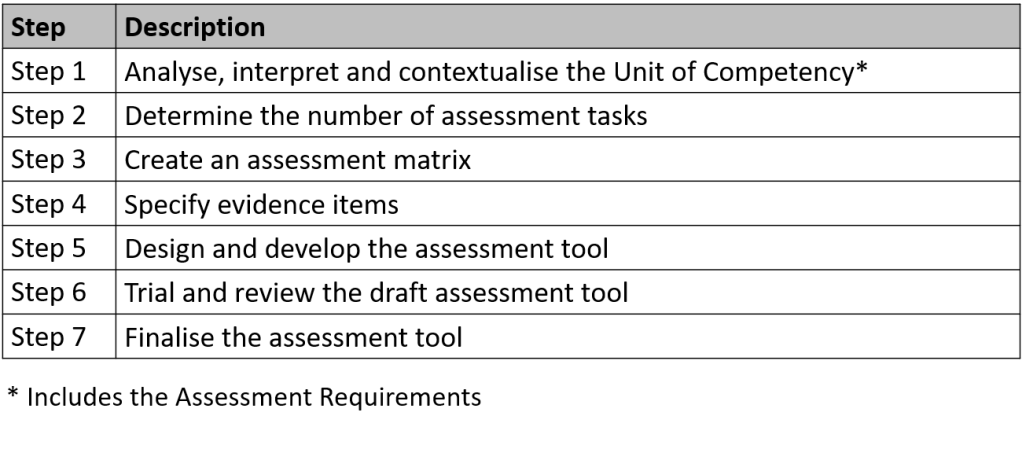
  • Describe a 7-step process for developing competency-based assessment
  • Determine the volume of performance evidence
  • Decide the number of assessment tasks
  • Check that the entire competency standard is planned to be assessed.

Key content points

The key content for this training are:

  • Compliance requirements (as per the Standards for RTOs 2015)
    • Definition of assessment
    • Principles of assessment and rules of evidence
  • Assessment Requirements
    • Knowledge evidence
    • Performance evidence
    • Assessment conditions
  • Sequence and structure of assessment tasks
  • Assessment methods
  • Assessment matrix
  • Assessment tools
    • Assessment instruments
    • Assessment instructions
  • Review and trial of the assessment tool before implementation
  • Nine golden rules when developing as assessment tool.

Location

The webinar shall be conducted via Zoom. Therefore, you can attend the webinar from your workplace or home.

Duration

3 hours webinar.

Note: There are two short breaks provided during the webinar.

Also, this webinar can be delivered to a work group. It can be a relevant and timely professional development activity for a group of trainers.

Date and start time

Please call Alan Maguire on 0493 065 396 to discuss.

Contact now!

logo otws

Training trainers since 1986

Webinar: How to design competency-based training

Most TAFE teachers, trainers and assessors working for an RTO learnt about designing competency-based training when they studied for their Certificate IV in Training and Assessment qualification . But designing a competency-based training program for real is often very different to learning about it at a TAE training course.

On Target Work Skills is delivering a training webinar that provides a simple and practical approach to designing competency-based training. The aim is to improve capability for new and experienced VET practitioners.

Webinar objectives

The training objectives are:

  • Identify compliance requirements relating to the design of competency-based training
  • Describe a 7-step process for designing competency-based training
  • Estimate total training duration
  • Develop a draft training agenda
  • Check that the entire unit of competency is covered
  • List the 6 essential elements of a training program plan.

Key content points

The key content for this training are:

  • Compliance requirements (as per the Standards for RTOs)
    • Definition of competency
    • Units of Competency and Assessment Requirements
  • Instructional design theory
    • Robert Gagné’s 9-events of instruction
    • David Merrill’s first principles of instruction
    • Malcolm Knowles’ assumptions about adult learners
  • 7-step process for designing competency-based training
  • Modes of delivery
  • AQF volume of learning and nominal hours
  • Chucking and sequencing
  • Training session structure
    • Introductions and conclusions
    • Structure of a knowledge training session
    • Structure of a skill or task-based training session
    • Summaries, self-reflection and breaks
  • Active learning and the importance of learn by doing
  • 6 essential elements of a training program plan.

Location

The webinar shall be conducted via Zoom. Therefore, you can attend the webinar from your workplace or home.

Duration

3-hour webinar

Note: There are two short breaks provided during the webinar.

Also, this webinar can be delivered to a work group. It can be a relevant and timely professional development activity for a group of trainers.

Date and start time

Please call Alan Maguire on 0493 065 396 to discuss.

Contact now!

logo otws

Training trainers since 1986

TAELLN421 Integrate core skills support into training and assessment

The TAELLN421 Integrate core skills support into training and assessment unit of competency can be difficult to read and understand because of the jargon it uses.

This unit has four elements:

  • Identify core skill demands
  • Identify learner and candidate core skill needs
  • Integrate core skill support
  • Review effectiveness of integrated core skill support.

Just looking at the elements of competency, there are a few questions raised:

  • What is a core skill?
  • What are core skill demands?
  • What is the difference between a learner and candidate?
  • What is core skills support?
  • What is meant by integrated core skill support?

What is a core skill?

There are five core skills in the Australian Core Skills Framework (ACSF):

  • Learning
  • Reading
  • Writing
  • Oral communication
  • Numeracy.

What are core skill demands?

I will use the word ‘requirement’ instead of the word ‘demand’. The following is an example of questions we can ask to help us determine the reading skill requirements:

  • What level of reading skill is required to perform a work task?
  • What level of reading skill is required to participate in the training and assessment?
  • What level of reading skill is required to use the training and assessment materials?

And ask the same questions for the other four core skills.

We use the Australian Core Skills Framework (ACSF) to determine the level of skill required.

What is the difference between a learner and candidate?

A learner is a person we provide training to. A candidate is a person we assess. Often, the learner and the candidate are the same person.

What is core skills support?

We can support the development of a person’s core skills by using training strategies and learning resources designed. For example:

  • We could allow more time for the person to learn the content
  • We could provide support sessions for the individual learner
  • We could use learning resources based on images and diagrams to help the person learn the content.

Also, we can use assessment strategies appropriate for the person being assessed. For example, we could use oral questioning instead of written questioning to gather knowledge evidence if the person has low level of reading and writing skills.

What is meant by integrated core skill support?

We need to address the development of the core skill at the same time as helping the person learn how to perform the work skills. For example, we can help a person develop their reading skill by helping them learn to read a relevant workplace procedure.

Also, ‘integrated core skill support’ means incorporating strategies and resources when we deliver training and conduct assessment. In other words, no doing something separately.

How do we integrate core skills support into training and assessment?

I have unpacked the elements, performance criteria and performance evidence to create the following 4-part process that gives greater clarity to the TAE Student about what they need to do.

Assessment requirements for the TAELLN421 unit

Knowledge evidence

An assessment task will be required to gather the specified Knowledge Evidence. A TAE Student must demonstrate they have the following knowledge:

  • Core skill levels of the Australian adult population, and of VET learners
  • Australian Core Skills Framework and Digital Literacy Skills Framework
  • Impact of core skills on a person’s capability to participate in work and in training and assessment, and the implications for design and delivery of vocational training and assessment
  • Overview of core skill demands in the workplace that relate to the nationally recognised training products
  • VET regulatory requirements relating to integrating core skills support into training and assessment
  • RTO procedures relating to integrating core skills support into training and assessment
  • Benefits of integrating vocational and core skill training for all individuals
  • How to identify core skills in nationally recognised training products, workplace tasks and texts, etc.
  • Responsibilities and limitations of own job and practice in relation to providing core skills support in training and assessment.

Performance evidence

The Performance Evidence for the TAELLN421 Integrate core skills support into training and assessment unit of competency is reasonably complex. This complexity may mean that the assessment task or tasks will be complex.

Do you need help with your TAE studies?

Are you a doing the TAE40122 Certificate IV in Training and Assessment, and are you struggling with your studies? Do you want help with your TAE studies?

Ring Alan Maguire on 0493 065 396 to discuss.

Contact now!

logo otws

Training trainers since 1986

Sneak preview of ‘How to implement the National Microcredentials Framework’

Anyone who knows me, knows that I love PowerPoint. And anyone who knows me, knows that I create PowerPoint presentations to support training programs I am designing, developing and delivering.

Recently, I have been delivering the ‘How to implement the National Microcredentials Framework’ training. Here is a sneak preview of some PowerPoint slides that I have developed for this training.

I hope you enjoy having a ‘walk-through the gallery’.

Which slide or slides do you like?

How to create powerful PowerPoint presentations

I am presenting a ‘How to create powerful PowerPoint presentations‘ training course. The following topics will be covered during this training course.

  • Design principles
  • Visual impact
    • Images
    • Visual style
    • Colour theme
  • Techniques
    • Guides and gridlines
    • Insert photos and icons
    • Re-size, rotate handles, and cropping
    • Insert tables, charts, and SmartArt Graphs
    • Simple animation
  • Rules
    • Don’t breach copyright
    • 6 x 6 rule
    • 10, 20, 30 rule.

And several learning activities will occur during this training course.

Look here for more details about the training course

logo otws

Training trainers since 1986